
 Road managers
 Accessibility tools




General Mass Limits (GML) are the basic mass limits that apply to all heavy vehicles, including individual axles and axle groups as well as mass limits for axle spacings of a heavy vehicle, as defined in the Heavy Vehicle (Mass, Dimension and Loading) Regulation (MDL).
GML states the mass limits for all types of heavy vehicle axle groups unless the vehicle is operating under an exception, an exemption (notice or permit), or PBS approval under the Heavy Vehicle National Law (HVNL).
Vehicles operating at GML can operate on the entire road network, subject to any restrictions imposed by local signage.
Regardless of mass limits, the loaded mass of a vehicle must not exceed the manufacturer’s rating, particularly the Gross Vehicle Mass (GVM) for a rigid vehicle or the Gross Combination Mass (GCM) for combinations or Aggregate Trailer Mass (ATM) for trailers. Also, the manufacturer’s mass rating on any component, such as a tow coupling, tyre, wheel or axle, must not be exceeded.
As per Schedule 1, section 2(1) of the MDL, the mass of a single vehicle or combination must not be more than the lowest of the following:
- the mass limit for a single vehicle or combination in Table 1: GML for single vehicle or combination
- the mass that is the sum of the mass limits stated in Table 2: Mass limits for a single axle or axle group in relation to each of the axle groups and single axles of the single vehicle or combination
- for a single vehicle or combination that is not a bus:
- if the reduced mass amount for the vehicle or combination is 55t or less — 1t more than the reduced mass amount for the vehicle or combination
- if the reduced mass amount for the vehicle or combination is more than 55t — 2t more than the reduced mass amount for the vehicle or combination.
See the Reduced mass amount webpage for information on how the reduced mass is calculated.
The mass limits of some common heavy vehicle combinations are shown in the Common Heavy Freight Vehicle Configurations chart (PDF, 955KB).
On this page
- Mass limits for a single vehicle or combination
- Mass limits for a single axle or axle group
- Definitions
- Axle spacing mass limits
Mass limits for a single vehicle or combination
Table 1 outlines some heavy vehicles and combinations and is not an exhaustive list.
| Description of combination | Mass limit |
|---|---|
| for a complying bus without a trailer - if the bus has only 2 axles but is not an eligible 2-axle bus | 16.0t |
| for a complying bus without a trailer - if the bus has a rear tandem axle group fitted with single tyres on 1 axle and dual tyres on the other axle but is not an eligible 3-axle bus | 20.0t |
| for a complying bus without a trailer - if the bus has a rear tandem axle group fitted with dual tyres on all axles | 22.5t |
| for a bus that is an ultra-low floor bus with no axle groups and only 2 single axles but is not an eligible 2-axle bus | 16.0t |
| for an eligible 2-axle bus | 18.0t |
| for an eligible 3-axle bus | 22.0t |
| for a complying steer axle vehicle* that is neither a B-double nor a road train | 44.0t |
| for a Euro VI vehicle (complying steer axle)** that is not a B-double nor a road train | 44.5t |
| for a Euro VI vehicle (single steer axle)*** that is not a B-double nor a road train | 44.0t |
| for a Euro VI vehicle (twinsteer)**** that is a prime mover with a twinsteer axle group towing a tri-axle semitrailer | 48.0t |
| for a prime mover with a twinsteer axle group towing a tri-axle semitrailer | 47.5t |
| for a vehicle that is not mentioned above and that is neither a B-double nor a road train | 43.5t |
Important considerations
If the distance between any 2 axles on a heavy vehicle that are not part of the same axle group is less than 2.5m, the mass of the heavy vehicle must not be more than 15t.
In a combination, the mass of a dog, pig trailer must not be more than the mass of the towing vehicle. This in effect is a maximum of 1:1 tow mass ratio.
For a rigid truck and tag trailer, the tow mass ratio is 1:1.3, and a requirement to have at least 20% of the sum of the mass limits applying to all of the axle groups and single axles of the towing vehicle.
Mass limits for twinsteer prime movers towing tri-axle semitrailers info sheet (PDF, 218KB)
Mass limits for eligible 2-axle buses under the Heavy Vehicle National Law (PDF, 334KB)
Mass limits for a single axle or axle group
The mass on a single axle or axle group must not be more than the mass limit described below.
| Axle | Description of single axle or axle group | Mass limit |
|---|---|---|
| Single axles and single axle groups | ||
 | Steer axles on— | |
| a complying bus that is not an eligible 2-axle bus or an eligible 3-axle bus | 6.5t | |
| a complying steer axle vehicle* | 6.5t | |
| a hauling unit or prime mover forming part of a road train fitted with tyres with section widths of— | ||
| 6.5t | |
| 7.1t | |
| an eligible 2-axle bus | 7.0t | |
| an eligible 3-axle bus | 6.5t | |
| Euro VI vehicle (complying steer axle)** fitted with tyres with section widths of— | ||
| 6.5t | |
| 7.0t | |
| Euro VI vehicle (single steer axle)*** | 6.5t | |
| another motor vehicle | 6.0t | |
| Single axle or single axle group fitted with single tyres with section widths of— | ||
| 6.0t | |
| 6.7t | |
| 7.0t | |
 | Single axle or single axle group fitted with dual tyres on— | |
| 8.5t | |
| 10.0t | |
| 11.0t | |
| 12.0t | |
| 9.0t | |
| Tandem axle group | ||
 | Tandem axle group fitted with single tyres with section widths of— | |
| 11.5t | |
| 13.8t | |
| 14.5t | |
 | Tandem axle group fitted with single tyres on 1 axle and dual tyres on the other axle on— | |
| a complying bus that is not an eligible 3-axle bus | 14.0t | |
| an eligible 3-axle bus with tyres on the axle fitted with single tyres that have a section width of at least 295mm | 15.5t | |
| another motor vehicle | 13.5t | |
 | Tandem axle group fitted with dual tyres on— | |
| 15.0t | |
| 17.0t | |
| Twinsteer axle groups | ||
| Twinsteer axle group without a load-sharing suspension system | 10.0t |
| Twinsteer axle group with a load-sharing suspension system` | 11.0t | |
| Euro VI vehicle (twinsteer)**** fitted with tyres with section widths of at least 275mm | 11.5t | |
| Tri-axle groups | ||
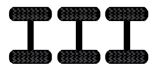 | Tri-axle group on a vehicle fitted with— | |
| 15.5t | |
| Tri-axle group on a pig trailer fitted with— | |
| 18.0t | |
| Tri-axle group on a vehicle other than a pig trailer fitted with— | ||
| 21.0t | |
| Quad-axle groups | ||
 | Quad-axle group fitted with single tyres with section widths of less than 375mm | 15.5t |
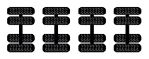 | Quad-axle group fitted with single tyres with section widths of at least 375mm or dual tyres | 21.0t |
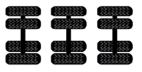
| Axle groups of 5 or more | ||
| Rear group of 5 or more axles on a low loader fitted with single tyres with section widths of less than 375mm | 15.5t | |
| Any other rear group of 5 or more axles on a low loader | 21.0t | |
Definitions
*A complying steer axle vehicle means a heavy vehicle with a single steer axle if the vehicle has all of the following—
- an engine complying with the emission control requirements contained in—
- ADR 80/01 or a later version of ADR 80; or
- if a version of ADR 80 later than ADR 80/01 applied to the vehicle at the vehicle’s date of manufacture—the version of ADR 80 that applied to the vehicle at the vehicle’s date of manufacture or a later version of ADR 80;
- a front underrun protection device that complies with UN ECE Regulation No. 93 or ADR 84;
- a cabin that complies with UN ECE Regulation No. 29;
- appropriately rated tyres, axle and suspension to permit 6.5t on the steer axle;
- a GVM of 15t or more.
The allowable GVM/GCM may also be increased by up to 0.5t for vehicles meeting the above conditions.
Note: The additional 0.5t applies to the allowable GVM/GCM only and does not increase the 6.5t steer axle mass limit.
**A Euro VI vehicle (complying steer axle) means a heavy motor vehicle with a single steer axle that—
- has an engine complying with the requirements about emission control contained in ADR 80/04 or a later version of ADR 80; and
- has a front underrun protection device that complies with ADR 84, unless ADR 84 provides otherwise; and
- has a cabin that complies with UN ECE Regulation No. 29; and
- has appropriately rated tyres, axle and suspension for the mass limit on the steer axle as stated by the vehicle’s manufacturer; and
- has a GVM of 15t or more; but
- does not include a bus.
***A Euro VI vehicle (single steer axle) means a heavy motor vehicle with a single steer axle, other than a complying steer axle vehicle, that—
- has an engine complying with the requirements about emission control contained in ADR 80/04 or a later version of ADR 80; and
- has appropriately rated tyres, axle and suspension for the mass limit on the steer axle as stated by the vehicle’s manufacturer; but
- does not include a bus.
****A Euro VI vehicle (twinsteer) means a heavy motor vehicle with a twinsteer axle group that—
- has an engine complying with the requirements about emission control contained in ADR 80/04 or a later version of ADR 80; and
- has a load-sharing suspension system for the axle group; and
- has appropriately rated tyres, axles and suspension for the mass limit on the axle group as stated by the vehicle’s manufacturer; but
- does not include a bus.
- heavy motor vehicles forming part of a road train.
Note: For more information on Euro VI vehicles, please see ADR 80/04 (Euro VI) emissions mass limits increase - Information sheet (PDF, 316KB).
Axle spacing mass limits
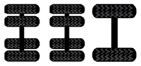
Mass limits are impacted by the length of the axle spacing. Figure 1 below shows the measurement points to determine axle spacing, including the:
- distance from the centre-line of single axle to the centre-line of another single axle;
- distance from the centre-line of single axle to the centre-line of the furthest axle in any axle group
- greatest distance between the centre-line of axles in any 2 axle groups.

