
 Road managers
 Accessibility tools


VSG5 - Converting a vehicle into a motorhome
VSG5 - Converting a vehicle into a motorhome
National
Heavy
Vehicle
Regulator
This guide provides advice about the heavy vehicle safety standard requirements that will need to be considered when converting a vehicle into a motorhome that will have a Gross Vehicle Mass (GVM) greater than 4.5 tonnes.
Converting a vehicle into a motorhome can be a complex process and, unless done correctly, could make the vehicle unsafe for the driver, passengers and other road users.
This guide is not an exhaustive list of all the modifications that can be undertaken when converting a vehicle into a motorhome, but provides a summary of the most common modifications and how these modifications need to be undertaken to ensure the motorhome complies with the Heavy Vehicle National Law (HVNL) and other legislation and regulations.
On this page
- Selecting a suitable vehicle
- Requirements for converting to a motorhome
- General safety requirements
- Ventilation
- Minimum motorhome requirements
- Driver’s view
- Lighting and reflectors
- Seating positions
- Seatbelts
- Child restraint anchorages
- Doors
- Windows
- Fire extinguishers
- Liquefied Petroleum Gas
- Electrical
- Television/visual display unit
- Toilets, sinks and showers
- Water tanks
- Exhaust outlet
- Vehicle mass
- Motorhome re-rating
- Approved Vehicle Examiners
- Resources
Note: Be aware that some modifications will need to be certified and approved by an Approved Vehicle Examiner (AVE). If there are a number of modifications taking place, you should consult an AVE before undertaking the conversion, especially if the conversion is likely to require the vehicle’s gross vehicle mass (GVM) to be re-rated.
More information can be found at Heavy vehicle modifications | NHVR.
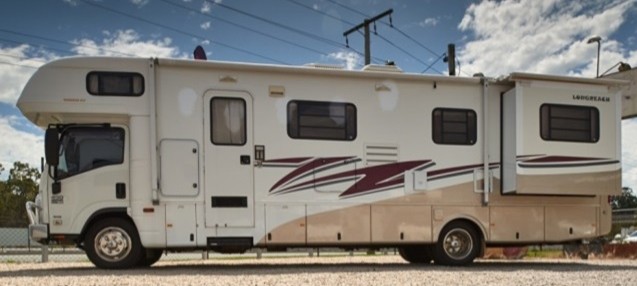
Selecting a suitable vehicle
The first step in any conversion project will be to select the right vehicle. While you can change many items during the conversion process, there are some factors that either cannot be changed or will need extensive modifications to correct.
When selecting a vehicle, some important issues you should consider are:
Steering position
In Australia all heavy vehicles must be right hand drive. If you select a left hand drive vehicle for your motorhome you will need to convert it to right hand drive, which is expensive.
Importing vehicles
All imported heavy vehicles must comply with both Australian Government vehicle importation requirements and the HVNL. The HVNL requires vehicles to be right-hand drive.
General mechanical and structural condition
Making sure the vehicle is in good mechanical condition and is structurally sound will make converting and using a motorhome easier. Before purchasing a vehicle, you may wish to have an independent mechanic look over the vehicle to give you peace of mind.
Gross vehicle mass, carrying capacity and gross combination mass
For a vehicle to be used on a road, it cannot exceed its maximum weight limit, which is the lesser of what is commonly known as the gross vehicle mass (GVM) or the axle mass limits applicable to the vehicle.
The GVM is the total weight allowable for the vehicle. The weight of the vehicle includes any fixtures or fittings on the vehicle and any passengers, luggage, food, water, waste water, etc. that is carried on board.
Axle mass limits are set by the HVNL and limit the amount of weight you can carry on an axle or axle group depending on the number of axles and the number and type of tyres.
More information can be found at Mass and dimension.
When selecting a vehicle, make sure it has a GVM that allows for your completed vehicle, including all of the belongings, food, water (clean and waste) and the people it will be carrying.
If you intend to tow a trailer or car, you should also consider if the vehicle and tow combination will have an adequate gross combination mass (GCM). The GCM is the total maximum loaded mass of the motor vehicle and any vehicles it may lawfully tow at any given time.
Size and dimensions
There are strict limits on the maximum dimension of a heavy vehicle. In particular motorhomes must not exceed the regulation dimensions, including:
- length: 12.5 metres
- width: 2.5 metres or 2.55 metres if a Safer Freight Vehicle
- height: 4.3 metres
- rear overhang: 3.7 metres or 60% of the wheel base, whichever is lesser and including items or equipment mounted on the rear overhang.
All fittings to the motorhome, such as spare wheels, tow bars and awnings, must be fully contained within the above measurements and must not impede the safe operation of the vehicle.
More information on Safer Freight Vehicles can be found in VSG35 - Implementation of width changes for Safer Freight Vehicles (PDF, 316KB).
Information on combination lengths (e.g., a motorhome towing a trailer) can be found at Length | NHVR.
Requirements for converting to a motorhome
Converting a vehicle to a motorhome is made up of a number of more minor modifications, some or all of which may apply to you. Below is a list of the most common tasks or requirements that must be considered during a conversion and advice on the type of certification needed.
General safety requirements
All objects, fittings and appliances installed in a motorhome must be installed with a ‘safety first’ approach that minimises the risk of injury to all persons when the motorhome is both stationary and travelling.
Interior fittings must be designed and fitted so as to prevent injury to occupants. Hazardous projections, sharp edges and sharp corners are not permitted.
All chairs, tables and other living area fittings must be secured in such a way that they will not dislodge during travel and must be able to withstand substantial vibration and impact and securely hold their contents (for example when driving over unsealed or corrugated roads).
Positive latches on internal doors, including cupboard doors, are recommended and all interior fittings should be secured to withstand forces experienced during normal driving conditions.
External fittings or protrusions that are not technically essential to the operation of the vehicle and that are likely to increase the risk of injury to any person are not permitted.
Ventilation
Ample ventilation must be provided both while the motorhome is travelling and when stationary.
If the vehicle has 9 seating positions or less, then at least half the number of windows must be capable of being opened or the motorhome must be provided with an alternative method of ventilation.
If the vehicle has more than 9 seating positions the vehicle must also be fitted with ventilation systems additional to window and door openings. This may be flow-through ventilation or refrigerated air-conditioning. At a minimum, flow-through ventilation should be an inlet air vent and at least two rotary vents or a hatch in the roof towards the rear of the passenger compartment.
Adequate permanent external ventilation must be provided for all gas appliances, including where appliances (such as barbeques) are fitted externally to the vehicle and may be operated under an annexe or an awning.
Minimum motorhome requirements
In order to be classed as a motorhome, the following minimum equipment must be included in the vehicle:
- seats and a table
- sleeping accommodation
- cooking facilities
- storage facilities.
This minimum equipment must be rigidly fixed to the vehicle, but it is acceptable if the table is designed to be easily removed, for example to convert the area to sleeping accommodation.
State and territory registering authorities may have additional minimum requirements that need to be met before your vehicle can be registered as a motorhome.
Driver’s view
The driver of the vehicle must have an adequate view of traffic on either side of the vehicle and in all directions in front of the vehicle to enable the vehicle to be driven safely.
Lighting and reflectors
Motorhomes must be fitted with lights and reflectors that comply with the standards applicable to your particular vehicle. These will be found in either the Australian Design Rules (ADRs) or the Heavy Vehicle (Vehicle Standards) National Regulation (Part 6, Lights and Reflectors). Fitting lights that do not comply with either of these is prohibited and it is recommended to engage the services of a professional before altering or installing lights and reflectors.
Mandatory lights must not be obscured by any equipment or fittings.
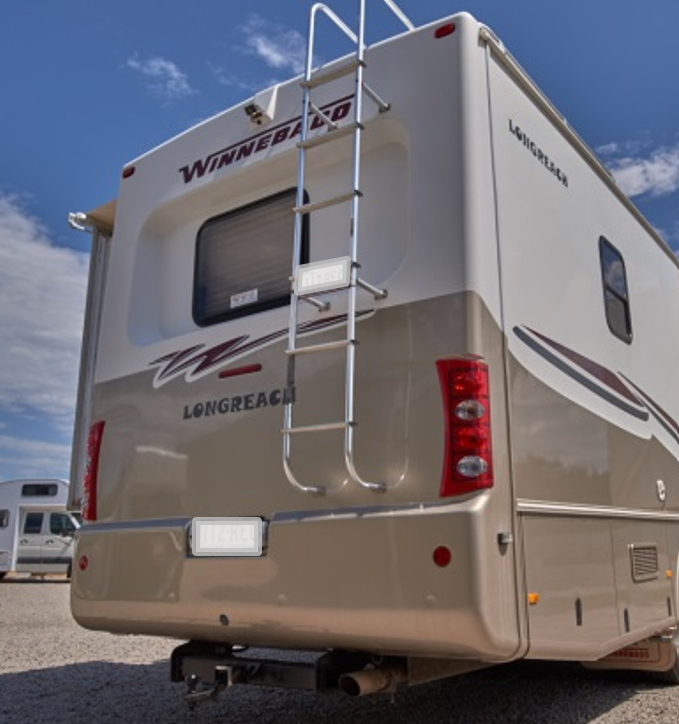
Seating positions
A motorhome must have at least one designated seating position (a seat that can be used when travelling on a road) for each sleeping berth that is in the motorhome, for example, a two berth motorhome must have a seating capacity of at least two. The NHVR strongly recommends that designated seating positions are forward facing and located towards the front of the vehicle.
Seats designed to swivel or adjust for recreational purposes must be capable of being locked against rotation to the position in which they will be occupied when the vehicle is in motion.
Installing new designated seats, or moving existing seats to a new position or orientation, is a modification that must be assessed and certified by an AVE.
Other seats in the motorhome that are not fitted with seatbelts and are not used when the vehicle is moving do not need to comply with the ADRs or heavy vehicle safety standards.
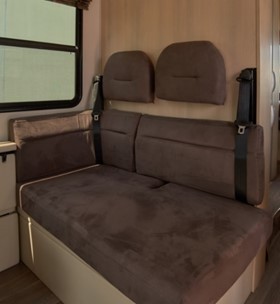
Seatbelts
There are 3 general rules for seatbelts when converting a vehicle to a motorhome:
- If you use a seat in a vehicle that was originally fitted when the vehicle was built, you do not need to add or change the seatbelt fitted.
- If you move an existing seat or fit a new seat – the vehicle must be fitted with new seatbelts that meet the current standards.
- Seatbelts can never be fitted to a non-designated seat.
Note: Where the modification results in a change of vehicle category, the seatbelts must comply with the requirements of the new category type based on the vehicle’s date of manufacture. However, it is strongly recommended that the requirments applicable at date of modification be used.Installing new seatbelts, or replacing seatbelts, is a modification that must be assessed and certified by an AVE.
Child restraint anchorages
It is not compulsory to fit child restraint anchorages (CRAs) to heavy vehicles which are converted to motorhomes; however, the NHVR does recommend they are installed if you plan on carrying children.
If you do choose to install CRAs, they must comply with the ADRs. You must also ensure that child restraint you intend to use is compatible with the child restraint anchorage you choose to install in your motorhome.
The installation of a CRA in a heavy vehicle is considered a modification and must be assessed and certified by an AVE to modification code K6.
Remember, while it is not compulsory to fit child restraint anchorages to motorhomes, it is always compulsory for children travelling in motorhomes to be restrained. Before allowing children to travel in the motorhome you are driving you should ensure the child restraints you intend on using are fitted and will function in accordance with your state or territory’s legal requirements.
Doors
Every motorhome must be fitted with at least one outward-opening or sliding door on the left-hand side or the rear of the vehicle. Outward security doors fitted over bi-fold or inwards folding doors are not categorised as outward opening doors for this purpose.
Doors must provide a clear and direct path of access between the outside and inside of the residential area of the motorhome.
The door:
- must not be obstructed by any items such as furniture or a designated seating position.
- must be sufficiently close to the ground so that it can be accessed without steps or with a minimal number of fixed steps and does not require portable steps of any kind.
- should be of a size which allows an average-sized person to easily and directly enter and exit the residential area of the motorhome.
Windows
Transparent materials, including glass, used in any newly fitted windscreen, window or interior partition must be an approved material complying with ADR8/.. In addition, glass fittings must be clearly marked with compliance information.
Restrictions also apply to the level of tint of windows. Further information can be found in the National Heavy Vehicle Inspection Manual (NHVIM) Section 10 Windscreens and Windows (PDF, 413KB).
Fire extinguishers
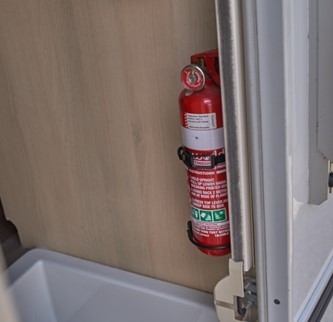
Every motorhome must contain at least one fire extinguisher with a minimum rating of 5B, which also complies with Australian Standard 2444 – Portable Fire Extinguishers and Fire Blankets. At least one of these fire extinguishers must be securely mounted in the living space of the motorhome, in a readily visible and accessible position no higher than 1.2 metres from the floor of the living space. The mounting bracket must also comply with Australian Standard 2444. It must be able to withstand the forces that result from impact or braking and must be designed such that the fire extinguisher does not dislodge during travel.
Liquefied Petroleum Gas
Liquefied Petroleum Gas (LPG) appliances, such as stoves and water heaters, must be installed by a licenced gas installer and each appliance must be accompanied by an Installation Compliance Certificate, which identifies the vehicle by its Vehicle Identification Number (VIN)/Chassis number. Gas appliances must comply with the Australian Standards and the manufacturer’s specifications.
Where the motorhome’s engine runs on LPG fuel, gas appliances must not be connected to, or derive fuel from, the engine’s fuel system in any way. Gas piping must be protected from abrasion where it passes through partitions or parts of the vehicle. Piping must not be exposed to the living space of the motorhome. LPG cylinder compartments must be stored securely and separately from the living space of the motorhome in a storage compartment that is constructed and ventilated to the Australian Standard AS/NZS 5601 – Gas Installations.
More information about gas systems can be obtained from your state or territory agency responsible for gas systems.
Electrical
Where electrical systems are capable of being connected to mains electricity, electrical installations and connections must be carried out by a licensed electrician and the motorhome must contain an Electrical Safety Certificate showing compliance with Australian Standards AS/NZS 3000 and AS/NZS 3001.
If you are installing a solar panel or solar generated electricity you will need to comply with the Australian Standard AS/NZS 5033 and AS/NZS 3000. The NHVR recommends you engage the services of a licensed electrician to do this.
All other vehicle electrical wiring must be done in accordance with the Heavy Vehicle (Vehicle Standards) National Regulation, Schedule 2, Part 2, Section 17.
Television/visual display unit
All television receivers or visual display units and associated equipment must be securely mounted in a position which:
- does not obscure the driver’s vision
- does not impede driver or passenger movement in the vehicle
- is unlikely to increase the risk of occupant injury
- is not visible to the driver from the driving position—with the exception of driver aids (e.g. satellite navigations systems).
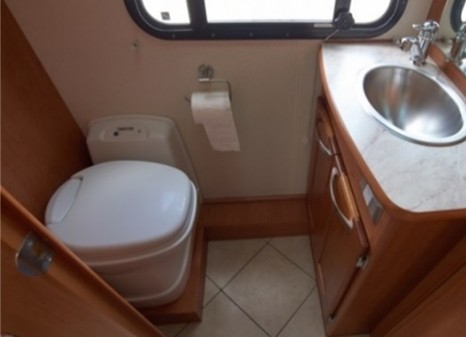
Toilets, sinks and showers
Any toilet or urinal installed in a motorhome must:
- empty into an externally vented tank which is securely attached to the motorhome. Systems that discharge directly to the ground are prohibited.
- discharge into a tank that contains non-inflammable and non-irritant chemicals which form an efficient deodorant and germicide.
- vent directly to the atmosphere.
Any sink or shower installed in a motorhome must:
- not drain into any toilet pan, urinal or any tank to which a toilet pan or urinal empties.
Water tanks
Any fresh, grey and black water tanks installed in a motorhome must be securely mounted to the vehicle. Tanks should be easily accessible for repairs, maintenance, removal and replacement and should be located with consideration given to the distribution of the mass of the tank when full. Shut-off valves and threaded connections to the tanks should be easily accessible for connecting hoses for drainage.
Exhaust outlet
The exhaust outlet must comply with the ADRs that applied at the date the vehicle was built as well as the requirements of the Heavy Vehicle (Vehicle Standards) National Regulation. In particular:
- Horizontal exhaust outlets must discharge rearwards or to the right of the vehicle, either horizontally or at a maximum of 45° downwards, must be located behind the rearmost seating position and must not extend beyond the perimeter of the vehicle.
- Vertical exhaust outlets must be located behind the rear most designated seating position and must meet one of the following requirements:
- the orifice must be a horizontal cross-section of the exhaust pipe and must direct the exhaust gases vertically upwards, or
- the orifice must be angled and orientated so that the principal flow of the exhaust gases is directed to the rear of the vehicle and upwards, at an angle within 0°and 45°the longitudinal centreline of the vehicle.
- If a rain cap is fitted to a vertical exhaust, the rain cap must be installed so the hinge of the cap is at an angle of 90° (plus or minus 10°) to the longitudinal axis of the vehicle when viewed from above.
In some cases where a heavy vehicle, such as a truck, is converted, it may be necessary to move the exhaust outlet so that it complies with these requirements.
Some state and territory environmental agencies have further restrictions on the placement of exhaust outlets. Therefore vehicle owners should consult with their state or territory environmental agency before modifying their vehicle’s exhaust.
Vehicle mass
When converting a vehicle to a motorhome it is important to keep in mind the mass limits that apply to the vehicle. Some common vehicle mass terms that you should be familiar with are:
Tare weight: The weight of a vehicle that:
- is ready for service
- is fitted with all standard equipment, together with any options that are fitted
- is unoccupied and unladen
- has all fluid reservoirs (other than for fuel) filled to nominal capacity
- has 10 litres of fuel in the fuel reservoir or reservoirs (but excluding any loaded fuel in excess of 10 litres).
Gross vehicle mass (GVM):The maximum loaded mass of a vehicle (tare weight + load), specified by the vehicle’s manufacturer or, if the GVM has been modified, shown on the modification plate affixed to the vehicle.
Gross combination mass (GCM): Means the total maximum loaded mass of the motor vehicle and any vehicles it may lawfully tow at any given time.
Load: Anything carried on or in the vehicle, including people, goods, luggage, fuel, water, lubricants, personal items and anything else normally taken from the vehicle when it is not in use.
Carrying (load) capacity: The difference between the GVM and the tare weight.
Additionally, the vehicle must not exceed the manufacturer’s ratings, this includes GCM and axle load.
Motorhome re-rating
If the proposed mass of the converted vehicle is likely to exceed the current GVM, it may be possible to re-rate the vehicle to increase the GVM. Similarly, if a commercial vehicle or omnibus is used for a motorhome conversion, it is common that the original vehicle GVM may be considerably higher than the maximum laden mass possible for the vehicle as a motorhome. For example, if a bus is re-purposed for use as a motorhome, the carrying capacity is no longer required to be as high as it was for the vehicle’s original intended purpose as a bus. In this situation it may be possible to reduce the vehicles GVM to reflect the vehicle’s new purpose as a motorhome.
The situations where a motorhome’s GVM can be increased or decreased are very limited, so it is strongly recommended that an Approved Vehicle Examiner is consulted before starting a conversion which may affect a vehicle’s GVM rating. Any re-rating of a vehicle’s GVM must be assessed and certified by an AVE in accordance with the requirements of the NHVR Code of Practice for the Approval of Heavy Vehicle Modifications.
Approved Vehicle Examiners
Approved Vehicle Examiners (AVE) are members of private industry who are accredited to assess and certify modifications to heavy vehicles that are included in the NHVR Code of Practice for the Approval of Heavy Vehicle Modifications.
For contact details of an AVE in your area who can assist with a modification, please contact your state or territory transport authority as listed at Approved Vehicle Examiners (AVEs) | NHVR.
Resources
For information on converting a light vehicle (less than 4.5 tonnes GVM) to a motorhome refer to Vehicle Standards Bulletin 14, Section LH Body and Chassis, Code LH11 Campervan, Motorhome Conversion.
Registration and licensing
Vehicle registration
Registration requirements differ slightly between each state and territory, however as a general guide, motorhome owners can expect that during the registration process they may be asked to:
- provide certification documents for LPG systems, electrical connections and installations and plumbing
- provide a modification certificate for any modification that must be approved by an AVE
- present the vehicle for an inspection to ensure the vehicle is roadworthy, meets dimension limits and complies with the requirements for motorhomes.
For full details about registering a motorhome, contact your state or territory transport authority.
Driver licencing
The class of licence needed to drive a heavy vehicle will depend on the GVM of the vehicle and the number of axles. When selecting a vehicle, make sure you are aware what class of licence you will need to drive it, and whether any changes you make during the conversion will change the type of licence you need.
For more information about driver licencing, contact your state or territory transport authority.
References
The rules and regulations referred to in this guide can be found using the following links.
- Australian Design Rules (ADRs) – https://www.infrastructure.gov.au/infrastructure-transport-vehicles/vehicles/vehicle-design-regulation/australian-design-rules
- Heavy Vehicle National Law, Heavy Vehicle (Vehicle Standards) National Regulation, Heavy Vehicle (Mass, Dimension and Loading) National Regulation – www.nhvr.gov.au/hvnl
- NHVR Code of Practice for the Approval of Heavy Vehicle Modifications - www.nhvr.gov.au/hvmodifications
- Vehicle Standards Bulletins (VSBs) – https://www.infrastructure.gov.au/infrastructure-transport-vehicles/vehicles/vehicle-design-regulation/rvs/bulletins
- Australian Road Rules – https://www.ntc.gov.au/laws-and-regulations/australian-road-rules
- Australian Standards – https://www.standards.org.au/
Chain of Responsibility
The Primary Duty requires Chain of Responsibility parties to ensure, so far as is reasonably practicable, that they carry out their transport activities in a way that ensures public safety when heavy vehicles are used on a road.
Keeping up to date with vehicle standards and implementing them in your fleet is one part of your transport activities.
Complying with the national heavy vehicle safety standards
The operator of a heavy vehicle must ensure that their vehicle complies with the relevant Australian Design Rules (ADRs) and the Heavy Vehicle (Vehicle Standards) National Regulation. Using or permitting another person to use a defective heavy vehicle on a road is an offence.
A defective heavy vehicle is a vehicle that:
- does not comply with the heavy vehicle safety standards; or
- has a part that does not perform its intended function; or
- has deteriorated to an extent that it cannot be reasonably relied on to perform its intended function.
More information can be found at Heavy vehicle defects.
NHVR support
If you have questions or require further information, please contact the Vehicle Standards team.
Changes and updates
| Date | Summary | Links to resources and communications |
|---|---|---|
| 4 June 2026 | Reorganised content, updated content to reflect changes to the HVNL, moved Registration and Licensing and References section to Resources and changed format to printable webpage. | |
| November 2024 | Minor review to include safer freight vehicle details, updated ventilation content and references to Australian Standards. | |
| June 2021 | Minor review. | |
| May 2018 | Minor review. | |
| March 2015 | First published. |
