
 Road managers
 Accessibility tools


VSG7 - Modifications to New Vehicles
VSG7 - Modifications to New Vehicles
National
Heavy
Vehicle
Regulator
This guide provides advice for vehicle owners, modifiers, and dealers, modifying a heavy vehicle before the vehicle has been provided to a consumer for the first time in Australia.
On this page
- When is a vehicle provided?
- Modifications approved under the RVSA
- Modifications approved under the HVNL
- Resources
All road vehicles are required to meet certain regulatory requirements to ensure, amongst other things, they are safe, secure and environmentally friendly.
The Commonwealth Department of Infrastructure, Transport, Regional Development, Communications, Sport and the Arts (the Department of Infrastructure), are responsible for the road vehicle standards laws that apply to both heavy and light vehicles before they are provided to a consumer for the first time in Australia (provided).
Once a vehicle has been provided to a consumer, the in-service regulations apply. For heavy vehicles over 4.5 tonnes (in participating jurisdictions), the Heavy Vehicle National Law (HVNL) applies.
To accommodate the unique requirements of heavy vehicles, new vehicles almost always require some degree of customisation. Modifications are made before a vehicle is first provided to a consumer, the modified vehicle must meet the requirements of the Road Vehicle Standards Act 2018 (Cth) (RVSA).
This guide details the different types of modifications that may be performed, and the approvals required.
When is a vehicle provided?
The Department of Infrastructure has published a guidance note explaining when a road vehicle is considered to have been provided to a consumer for the first time. It advises that a vehicle has been provided when the following conditions have been met:
- the vehicle has been correctly entered on the Register of Approved Vehicles (RAV); and
- a contract of sale has been entered into between the consumer and either an Original Equipment Manufacturer (OEM) or dealership.
Note: This does not include a contract between an OEM and a dealership, or vehicles sold for a second stage of manufacture.
Modifications approved under the RVSA
The following modifications can be made to a vehicle that has been entered on the RAV, but before it is provided to a consumer for the first time in Australia:
- modifications carried out in accordance with the written instructions of the holder of the vehicle type approval.
- modifications carried out during second stage of manufacture in accordance with a vehicle type approval.
- modifications carried out during second stage of manufacture in accordance with an applicable Model Report that applies to the vehicle.
- modifications carried out in accordance with Vehicle Standards Bulletin 6 (VSB6), as in force in the State or Territory in which the vehicle was modified at the time the modifications were made.
Modifications carried out in accordance with VSB6
Modifications carried out in accordance with VSB6 prior to the vehicle being provided to the consumer must be:
- assessed and certified by an Approved Vehicle Examiner, and
- fitted with a modification (blue) plate.
Modifications carried out in accordance with the type approval holder’s written instructions
Modifications carried out in accordance with the type approval holder’s written instructions before the vehicle is provided to a consumer are classed as part of the vehicle build and do not need additional certification. When an approval holder provides written instructions for modifications, they accept responsibility for the design and fitment of such items.
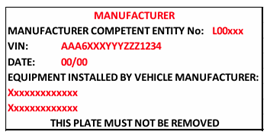
To assist vehicle owners, enforcement officers and vehicle inspectors to identify when modifications have been undertaken in this manner, from May 2015, an optional label (known as a Manufacturer’s Plate) may be fitted to the vehicle by the Approval Holder, or their representative.
The Manufacturer’s Plate provides information about what original equipment was installed and may also include important safety information (refer to Figure 1).
More information can be found in the Voluntary Code of Practice (for Heavy Vehicles) Manufacturer’s Plates | Truck Industry Council.
Modifications approved under the HVNL
The following types of modifications may be made to a vehicle after it has been provided to a consumer for the first time in Australia:
- minor modifications
- common modifications (performed in accordance with VSB6)
- complex modifications.
Note: Further information on vehicle modification methods after a vehicle has been provided to a consumer can be found in the NHVR Code of Practice for the Approval of Heavy Vehicle Modifications.
Resources
Chain of Responsibility
The Primary Duty requires Chain of Responsibility parties to ensure, so far as is reasonably practicable, that they carry out their transport activities in a way that ensures public safety when heavy vehicles are used on a road.
Keeping up to date with vehicle standards and implementing them in your fleet is one part of your transport activities.
Complying with the national heavy vehicle safety standards
The operator of a heavy vehicle must ensure that their vehicle complies with the relevant Australian Design Rules (ADRs) and the Heavy Vehicle (Vehicle Standards) National Regulation. Using or permitting another person to use a defective heavy vehicle on a road is an offence.
A defective heavy vehicle is a vehicle that:
- does not comply with the heavy vehicle safety standards; or
- has a part that does not perform its intended function; or
- has deteriorated to an extent that it cannot be reasonably relied on to perform its intended function.
More information can be found at Heavy vehicle defects | NHVR.
NHVR support
If you have questions or require further information, please contact the Vehicle Standards team.
Changes and updates
| Date | Summary | Links to resources and communications |
|---|---|---|
| May 2026 | Review to remove specific references in the HVNL, update language and format change to a printable webpage. | |
| February 2022 | Major review. | |
| 2016 | First published. |
