
 Road managers
 Accessibility tools


South Australia Class 3 Livestock Transportation Mass and Dimension Exemption Notice Operator’s Guide
South Australia Class 3 Livestock Transportation Mass and Dimension Exemption Notice Operator’s Guide
National
Heavy
Vehicle
Regulator
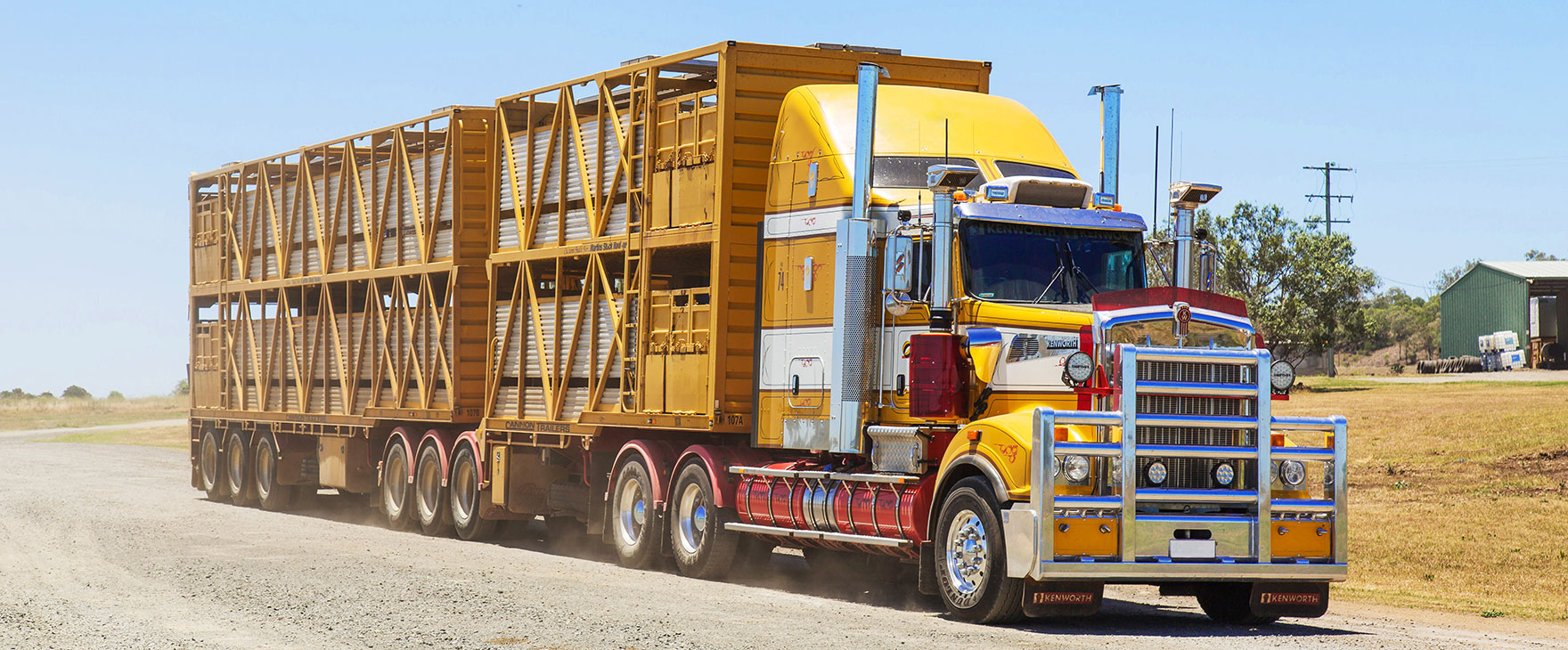
The South Australia Class 3 Livestock Transportation Mass and Dimension Exemption Notice 2026 (No.1) grants exemptions from mass and dimension requirements under the Heavy Vehicle (Mass, Dimension and Loading) National Regulation (MDL) for Class 3 heavy vehicle combinations used for the transportation of livestock.
Note: The Notice provides an exemption from certain heavy vehicle mass and length limits outlined in the MDL for Class 3 vehicles operating in South Australia.
This instrument does NOT exempt these vehicles from other requirements of the Heavy Vehicle National Law (HVNL), including, but not limited to, mass and other dimension requirements.
| Specifications | |
|---|---|
| Gazette Notice: | C2026G00196 |
| Starts: | 01 April 2026 |
| Expires: | 2 November 2028 |
| Vehicle types: | Class 3, prime mover towing a semitrailer combination, B-double, road trains |
| Exemptions: |
Mass requirements (steer axle mass limits, axle mass limits, axle spacing mass limits, axle group mass limits, general combination mass, single vehicle mass) Dimension requirements (general length, combination length) |
| Law: | HVNL, MDL |
| Coverage: | SA |
| To be carried: | No |
- Overview
- Definitions
- Eligible
Vehicles - Conditions
- Network and
Mapping - Related
Notices - Resources
- Changes and
Updates
Overview
The information in this Operator’s Guide is intended to do two things:
- Explain how the South Australia Class 3 Livestock Transportation Mass and Dimension Exemption Notice 2026 (No.1) (the Notice) operates, to assist in complying with it. The Notice provides the exemptions and takes priority if there is any difference or misunderstanding between the Operator’s Guide and the Notice. The only exceptions are the requirements or conditions set out in the ‘Network and Mapping’ section, explained below.
- Provide additional information referred to in the network requirements of the Notice. This includes links to network maps and other information such as vehicle, travel and road conditions. Networks and their conditions published in the ‘Network and Mapping’ section of this Operator’s Guide are not general advice and must be treated as conditions of the Notice.
Please read the Notice and this Operator’s Guide together. To download or print this guide, use the print or PDF buttons on the top right of this page.
About this Notice
The Notice provides a Class 3 heavy vehicle that is a prime mover towing a semitrailer, a B-double or road train used for the transportation of livestock, with exemptions from specified mass and dimension requirements under the Heavy Vehicle (Mass Dimension and Loading) National Regulation (MDL).
Exemptions
These exemptions only apply to the extent to which conditions are granted.
Dimension exemptions
An eligible vehicle that is a B-double combination operating under this Notice is exempt from the following dimension requirements of Schedule 6 of the MDL:
- section 3 - Length (combination or single vehicle).
The exemption only applies to vehicle or component length limits. If more than one dimension limit applies, the lower dimension limit applies.
Mass exemptions
The Notice exempts eligible vehicles from the following mass requirements specified in Schedule 1 of the MDL:
- section 2 - Mass limits for a single vehicle or combination.
- section 3 - Mass limits for a vehicle with a particular axle space less than 2.5m.
- section 4 - Mass limits for a single axle or axle group.
- section 5 - Mass limits in relating to axle spacing generally.
Additional or conditional mass allowed under this Notice must not exceed manufacturer mass limits as outlined in section 8 of the MDL.
The exemption only applies to combination mass and axles mass limits. If two or more mass limits are provided that impose different limits, the lower limits apply.
Note: Other mass and dimension limits in the MDL apply.
Definitions
The following are terms used in this Notice or conditions of operation. Unless otherwise stated, words and expressions used in this Notice have the same meaning as defined in the HVNL.
|
Term |
Definition |
|---|---|
|
ADR |
Australian Design Rules. |
|
Class 3 heavy vehicle |
A heavy vehicle is a Class 3 heavy vehicle if:
|
|
Dual-drive tandem axle group |
A tandem axle group consisting of two axles, both of which are a driving axle for a vehicle. |
|
General access |
Access to all roads in South Australia, except as restricted by the 'Specified road manager network requirements' in the Guide. |
|
Livestock |
As defined in the Animal Welfare Regulations 2012 (SA). |
|
MDL |
Heavy Vehicle (Mass, Dimension and Loading) National Regulation. |
|
Single axle group |
Two or more axles where the outer centre-lines are less than 1m apart. |
|
Steer axle |
The front steerable axle used to steer the vehicle. |
|
Tandem axle group |
A group of at least two axles with the outermost axles at least 1m (but not more than 2m) apart. |
|
Tri-axle group |
A group of at least three axles, in which the horizontal distance between the centre-lines of the outermost axles is more than 2m but not more than 3.2m. |
|
VS Regulation |
Heavy Vehicle (Vehicle Standards) National Regulation. |
Eligible vehicles
To be eligible to operate under the Notice, approved combinations must comply with the conditions of the Notice and all other requirements of the MDL.
An eligible vehicle is a combination consisting of:
- a prime mover and a semitrailer shown in Table 1; or
- a combination that is a B-double shown in Table 1; or
- a road train combination shown in Table 1.*
*Please note that not all road train combinations are eligible to operate under the notice. Operators should refer to the Notice to confirm what road train combinations can operate under the Notice.
| Description | Image of eligible vehicle |
|---|---|
| Single steer tandem drive axle | 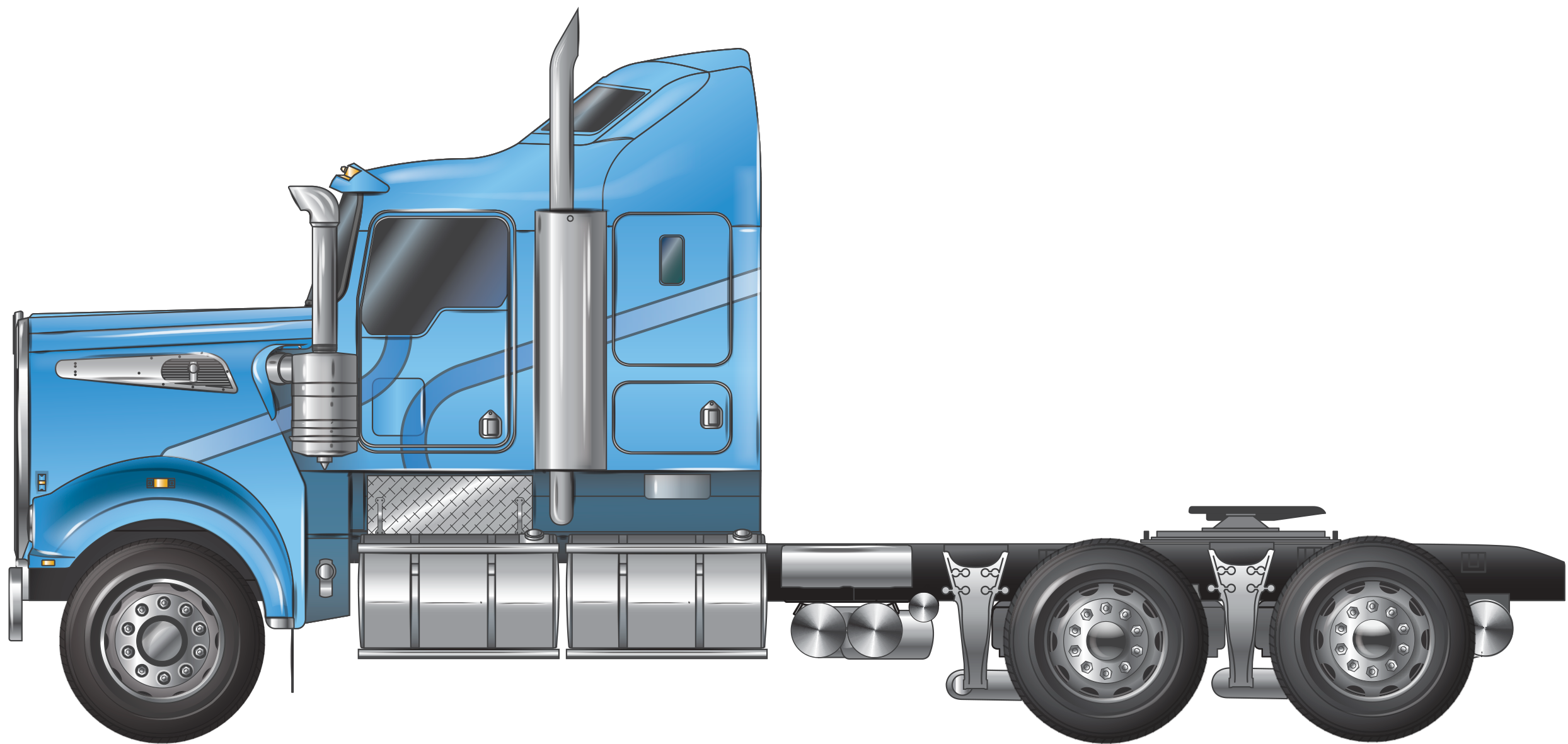 |
| Twin steer tandem drive axle | 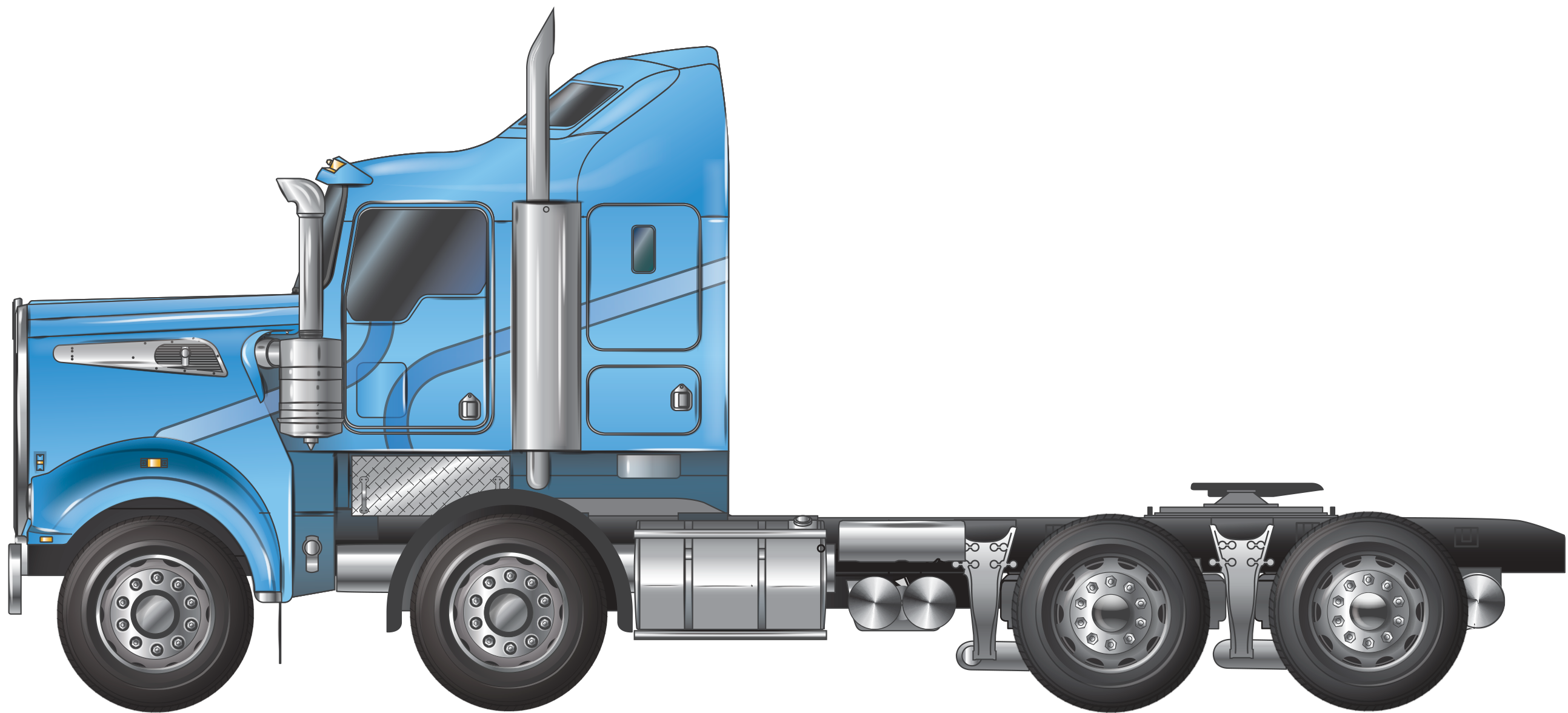 |
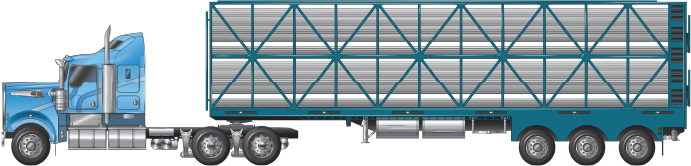
| Prime mover towing a semitrailer up to 19.0m in length |
|
| B-double combination up to 27.5m in length |
|
| A-double (3-2-3) up to 30.0m in length |
|
| B-triple (3-3-3) up to 36.5m in length |
|
| AB-triple (3-3-3-3) up to 44.0m in length |
|
| ABB-quad (3-3-3-3-3) up to 53.5m in length |
|
| BAB-quad (3-2-3-3-3/3-3-3-3-3) up to 53.5m in length |
|
| Note: Table 1 is indicative of the eligible vehicles that can operate under the Notice. Please refer to the Notice for a comprehensive list of eligible vehicles. | |






Conditions
Notices are subject to various conditions to ensure public safety, protect assets and prevent adverse impacts on the community, such as noise, emissions and traffic congestion. See the sections below for specific conditions related to this Notice.
Dimension conditions - Click to expand
Length
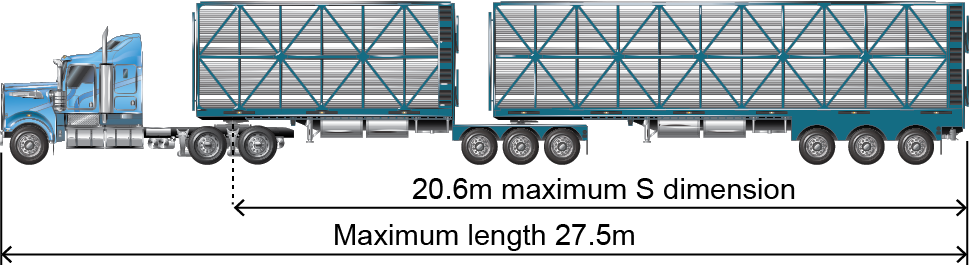
Under the Notice, only a B-double combination vehicle is exempt from the dimension requirements under Schedule 6, section 3 of the MDL. The eligible B-double combination must not exceed 27.5m in length and must have an S dimension no longer than 20.6m in length (Figure 1).
Transportation of livestock only
An eligible vehicle combination must be used for the transportation of livestock to be defined as an eligible vehicle under the Notice. The load must be entirely composed of livestock. No other type of load may be transported.
Mass conditions - Click to expand
Certified Road-Friendly Suspension (RFS)
Certified Road-Friendly Suspension (RFS) reduces the impact of laden axles on road pavements and most bridge structures.
An eligible vehicle must have functioning certified RFS fitted to each of the following axle groups:
- Dual-drive tandem axle group.
- Tri-axle group on any trailer.
- Tandem axle group on any trailer forming part of a road train.
For additional information about certified RFS, refer to Vehicle Standards Bulletin (VSB) 11 - Certification of Road-friendly Suspensions.
Please note that leaf-spring systems can operate under the Notice provided they are Vehicle Standards Bulletin (VSB) 11 compliant.
Mass limits
Axle mass limits
An eligible vehicle must not exceed the following axle mass limits listed in Table 2:
| Axle group/tyres | Axle | Axle/vehicle requirements | Tyre section width | Mass limit (t) |
|---|---|---|---|---|
| Steer axle |  |
Default limit | N/A | 6.0 |
| Complying steer axle | Suitability rated | 6.5 | ||
| Road train steer axle | 295–375 mm | 6.5 | ||
| At least 375 mm | 7.1 | |||
|
Steer axle Euro VI vehicle (prime mover and semitrailer or B-double) |
|
Single steer axle | N/A | 6.5 |
| Complying steer axle | 7.0 | |||
|
Twinsteer axle group Single tyres |
 |
Non-load-sharing suspension system | N/A | 10.0 |
| Load-sharing suspension system | N/A | 11.0 | ||
|
Twinsteer axle group Single tyres Euro VI vehicle (prime mover and semitrailer or B-double) |
 |
Euro VI | N/A | 11.5 |
| Dual-drive tandem axle group |  |
Dual tyres on all axles | N/A | 17.3 |
|
Dual-drive tandem axle group Euro VI vehicle Mass transfer allowance (prime mover and semitrailer or B-double) |
|
Dual tyres on all axles | N/A | 17.8 |
| Tandem axle group on any trailer forming part of a road train | |
Dual tyres on all axles | N/A | 17.3 |
| Tri-axle group on semitrailer forming part of a prime mover towing a semitrailer or B-double | 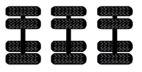 |
Dual tyres on all axles | N/A | 25.0 |
| Tri-axle group on any trailer forming part of a road train | |
Dual tyres on all axles | N/A | 23.0 |
Total combination mass
An eligible vehicle must not exceed the following total mass limits listed in Table 3:
- A combination consisting of a prime mover and a semitrailer 53.3t.
- A combination that is a B-double must not exceed 73.8t.
- A combination that is a road train must not exceed 143.3t.
| Description | Steer axle mass limit (t) | Dual-drive axle mass limit (t) | Tri-axle group (semitrailer) mass limits (t) | Tri-axle group (semitrailer) mass limits (t) | Total mass limit (t) | |||
|---|---|---|---|---|---|---|---|---|
| Single steer prime mover towing a semitrailer | 7.0* | 17.3 | 25.0 | N/A | 49.3 | |||
| Single steer B-double combination | 6.0** | 17.3 | 25.0 | 25.0 | 73.3 | |||
| Twinsteer prime mover towing a semitrailer | 10.0**** | 17.3 | 25.0 | N/A | 52.3 | |||
| Twinsteer B-double combination | 11.5*** | 17.3 | 25.0 | 25.0 | 78.8 | |||
| *Euro VI prime mover with a complying steer axle. ** Prime mover with a single steer axle. ***Euro VI prime mover with a twinsteer axle group. ****Prime mover with a twinsteer axle group without load sharing suspension. |
||||||||
| Road train combinations | ||||||||
| Description | Steer axle mass limit (t) | Dual-drive axle mass limit (t) | Tri-axle group (semitrailer) mass limits (t) | Tri-axle group (converter dolly) mass limits (t) | Tandem axle group (converter dolly) mass limit (t) | Total mass limit (t) | ||
| A-double (3-2-3) single steer up to 30.0m in length | 6.0^ | 17.3 | 46 (23.0+23.0) |
N/A | 17.3 | 86.6 | ||
| B-triple (modular) (3-3-3) single steer up to 36.5m in length | 6.5^^ | 17.3 | 46 (23.0+23.0) |
23.0 | N/A | 92.8 | ||
| B-triple (3-3-3) single steer up to 36.5m in length | 6.5^^ | 17.3 | 46 (23.0+23.0) |
23.0 | N/A | 92.8 | ||
| AB-triple (3-2-3-3) single steer (modular) up to 44.0m in length | 7.1^^^^ | 17.3 | 69.0 (23.0+23.0+23.0) |
N/A | 17.3 | 110.7 | ||
| AB-triple (3-3-3-3) single steer up to 44.0m in length | 6.5^^ | 17.3 | 69.0 (23.0+23.0+23.0) |
23.0 | N/A | 115.8 | ||
| BAB-quad (3-3-2-3-3) single steer up to 53.5m in length | 6.0^ | 17.3 | 92.0 (23.0+23.0+23.0+23.0) |
N/A | 17.3 | 132.6 | ||
| ABB-quad (3-3-3-3-3) single steer up to 53.5m in length | 7.1^^^^ | 17.3 | 115.0 (23.0+23.0+23.0+23.0+23.0) |
23.0 | N/A | 139.4 | ||
| A-double (3-2-3) twinsteer up to 30.0m in length | 11.0^^^^^^ | 17.3 | 46 (23.0+23.0) |
N/A | 17.3 | 91.6 | ||
| B-triple (3-3-3) twinsteer up to 36.5m in length | 10.0^^^^^ | 17.3 | 69.0 (23.0+23.0+23.0) |
N/A | N/A | 96.3 | ||
| B-triple (3-3-3) (modular) twinsteer up to 36.5m in length | 11.0^^^^^^ | 17.3 | 69.0 (23.0+23.0+23.0) |
N/A | N/A | 97.3 | ||
| AB-triple (3-2-3-3) twinsteer (modular) up to 44.0m in length | 11.0^^^^^^ | 17.3 | 69.0 (23.0+23.0+23.0) |
N/A | 17.3 | 114.6 | ||
| AB-triple (3-3-3-3) twinsteer up to 44.0m in length | 10.0^^^^^ | 17.3 | 69.0 (23.0+23.0+23.0) |
23.0 | N/A | 119.3 | ||
| BAB-quad (3-3-2-3-3) twinsteer up to 53.5m in length | 11.0^^^^^^ | 17.3 | 92.0 (23.0+23.0+23.0+23.0) |
N/A | 17.3 | 137.6 | ||
| ABB-quad (3-3-3-3-3) twinsteer up to 53.5m in length | 10.0^^^^^ | 17.3 | 92.0 (23.0+23.0+23.0+23.0) |
23.0 | N/A | 142.3 | ||
| Note: Table 3 is indicative of the eligible vehicles that can operate under the notice. Eligible vehicles can operate with a single or twin steer axle. Please refer to the Notice for a comprehensive list of eligible vehicles. ^ A prime mover with a single steer axle. ^^ A prime mover with a complying single steer axle. ^^^ A prime mover forming part of a road train that is fitted with tyres with section widths of at least 295mm. ^^^^ A prime mover forming part of a road train that is fitted with tyres with section widths of at least 375mm. ^^^^^ A prime mover with a twinsteer axle group without load sharing suspension. |
||||||||
General conditions - Click to expand
D rating of fifth wheel couplings and kingpins on B-doubles
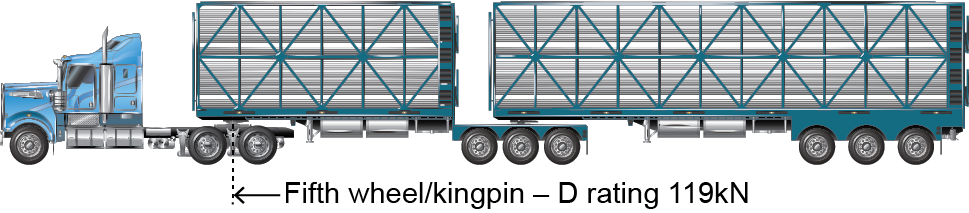
The D rating for a fifth wheel coupling or kingpin in a B-double combination must not be less than 119kN as shown in Figure 2.
Vehicle configuration and axle requirements
- The prime mover of an eligible vehicle must have a dual-drive tandem axle group.
- Any semitrailer that is part of a prime mover towing a semitrailer or a B-double must have a tri-axle group.
- All axles on an eligible vehicle other than the steer axle must have dual tyres.
- Any trailer forming part of a road train must have either a tandem axle group or tri-axle group, in the trailer configuration as specified in the Notice.
- All eligible vehicles must have either a single or twinsteer axle group.
Braking requirements for road trains
Most braking system requirements are made by the ADR to which the vehicle was constructed. A road train must continue to comply with those requirements.
The VS Regulation makes some additional requirements that apply to road train combinations. These include ensuring there is sufficient air pressure available in the braking system.
The ADRs have also mandated:
- anti-lock braking systems to be fitted on prime movers built from 1 January 2015
- vehicle stability control to be fitted on prime movers built from 1 July 2020
- rollover control systems to be fitted on heavy trailers built from 1 November 2019.
The ADRs' requirements apply to heavy vehicles operating in any state or territory in Australia.
Mechanical couplings and ratings for road trains
Mechanical couplings are the devices that connect one component vehicle of a combination to another. They include:
- fifth wheels, king pins and turntables
- pin-type couplings and drawbar eyes on converter dolly couplings.
Eligible road trains are defined in the Notice partly by the types of mechanical couplings with which they are fitted. A key difference between coupling types is their capacity to resist roll between the connected vehicles.
- Fifth-wheel assemblies that utilise two rotating plates are considered to be roll-coupled connections.
- Pin-type couplings and drawbar eyes - a feature of converter dollies - are not considered to be roll-coupled. The pin-type connection to the towing (forward) vehicle offers lesser resistance to roll.
Attachment of couplings and drawbar eyes on road trains
A drawbar-type coupling, or drawbar eye, used in a road train must be built and positioned so that:
- when the road train is moving, the drawbar can move at least 15º upwards or downwards from the position it occupies when the road train is parked on level ground; and
- the pivot point of the coupling is not more than 300mm forward of the rear of the trailer to which it is attached; and
- it is at a height of at least 800mm, but not more than 950mm, when the road train is unloaded and parked on level ground.
Key road train trailer couple strength requirements of ADR63/00
All road train trailers built from July 1991 onwards must comply with Australian Design Rule 63/00 - Trailers Designed for Use in Road Trains. ADR 63 requires that they be equipped with mechanical couplings meeting the standards and strength requirements shown in Table 8.
For road train trailers built before July 1991 and not subject to ADR 63/00, requirements made in the VS Regulation apply. Those include complying with the following
Australasian Standards and updated/later versions of these:
- AS 2175-1990: Articulated Vehicles – Kingpins
- AS 2213-1984: 50mm Pin-Type Couplings and Drawbar Eyes for Trailers
- AS/NZS 4968.1:2003: Heavy road vehicles –Mechanical coupling between articulated vehicle combinations.
These Australasian Standards describe a method to - and require operators to - calculate coupling strength requirements (minimum D-values). Example calculations are shown in Table 5. Alternatively, values no less than those required by ADR 63/00 and shown in Table 4 are acceptable.
| Coupling type | Relevant Australian Standards | Minimum D-value (kN) |
|---|---|---|
|
Fifth wheel |
1773-1990 |
162 |
|
Fifth wheel |
2175-1990 |
162 |
|
Pin-type |
2213-1984 |
186 |
| Coupling type | Relevant Australian Standards | Minimum D-value (kN) |
|---|---|---|
| A-double | Tandem-axle | 128 |
| A-triple | Tandem-axle | 161 |
| Tri-axle | 172 |
Other conditions and additional information
Assessing routes
Before an eligible vehicle is driven along any route, its driver and operator must be satisfied that the route has been assessed and that the vehicle can be driven along it without:
- disrupting telecommunication, electricity, rail, gas, water or sewage services; or
- damaging a road (including a bridge), structure, rail crossing or tree.
Third party approvals
Gazette notices, permits and some jurisdictional laws may require third parties and other entities to provide permission for a vehicle to travel if it exceeds certain mass or dimension limits.
Operators must secure all approvals from third parties such as electricity/utility companies, rail authorities and other third parties as part of their heavy vehicle operations.
For more information, visit the Third party approvals page.
Loading requirements
To meet the loading requirements, the heavy vehicle must be loaded:
- in a way that load placement does not make the heavy vehicle unsafe or unstable
- in a way that the load is not likely to fall or be dislodged from the vehicle
- using an appropriate system to restrain the load.
Visit the NHVR loading page for more information on load requirements.
Livestock transport
During the transport of livestock, operators and drivers must ensure they meet the loading density requirements as detailed in the Animal Welfare Regulations 2012 and the South Australian Department for Environment and Water - Animal welfare.
Complying with the HVNL
Unless otherwise exempted by the Notice or this Operator's Guide, operators must ensure their vehicle or combination complies with the:
- Australian Design Rules (ADRs); and,
- Heavy Vehicle National Law (HVNL); and,
- Heavy Vehicle (Mass, Dimension and Loading) National Regulation (MDL); and,
- Heavy Vehicle (Vehicle Standards) National Regulation (VS Regulation).
Using or permitting another person to use a defective heavy vehicle or a heavy vehicle with unapproved modifications on a road may be an offence.
Failure to comply may result in the driver and/or operator being liable for an offence. Penalties can include infringement notices or prosecution.
Chain of Responsibility (CoR)
Under the HVNL, every party in the Chain of Responsibility (CoR) has a positive duty to ensure the safety of their activities in relation to a heavy vehicle. This duty, known as the “primary duty”, applies to the scheduling, loading and consigning of a vehicle, as well as to its operation on a road.
Safety is broader than the safety of drivers and other road users. It also includes protection of road infrastructure, preventing damage to other vehicles or property, and minimising environmental harm. Substantial penalties may be imposed upon parties who breach this obligation and upon their executives.
For more information on your CoR obligations visit Chain of Responsibility on the NHVR website.
Our Regulatory Advice offers guidance, tips and tools for managing a range of heavy vehicle safety risks.
The requirement to carry the Notice
Drivers do not need to carry a copy of the Notice.
Network and mapping
For the purposes of s121 of the HVNL, an area or route specified in the 'Network & Mapping' section of this Operator's Guide is a stated area or route to which this Notice applies. In addition to complying with the conditions stated in this Operator's Guide, operators must ensure compliance with the specific road manager access requirements set out below or in network maps.
In this tab, you will find the approved routes authorised under the Notice. There may also be network conditions pursuant to the stated areas and routes under the Notice. Network conditions relate to road and travel conditions that are not contained within the Notice.
National Network Map
This Notice may refer to state or territory government websites for the publication of networks. Certain authorised heavy vehicle road network maps for the Australian Capital Territory, New South Wales, Queensland, South Australia, and Victoria are published by the National Heavy Vehicle Regulator, through the NHVR National Network Map. Additional information and guidance can be found on the National Network Map webpage.
Approved routes covered by the Notice
The following routes are approved for travel for vehicles eligible under this Notice.
Eligible vehicles can operate on the networks in Table 6, subject to Notice and network conditions.
Note: Networks for road train combinations include state roads only. Access to council areas will require a permit application through NHVR Go.
Approved routes covered by the Notice - Click to expand
Both single steer and twinsteer variants are eligible to operate on some of the networks in Table 6, so long as they comply with the described:
- combination type (e.g. B-double or AB-triple)
- combination length (e.g. 36.5m in length
- trailer axle configuration (e.g. 3-2-3 or 3-2-3-3).
For example, a twinsteer A-double (3-2-3) as well as a single steer A-double (3-3-3), both of which are up to 30m in length, may operate on the South Australia Livestock Loading Scheme 30.0m A-double Network.
However, a twinsteer AB-triple (3-2-3-3) and a single steer AB-triple (3-3-3-3), despite both being 36.5m in length, operate on two different networks, since their trailer axle configurations vary.
A single steer AB-triple (3-3-3-3) and a twinsteer AB-triple (3-3-3-3), with varying lengths of 42m and 44m, operate on two different networks, since their combination lengths vary.
| Eligible vehicle | Network or route |
|---|---|
| Prime mover towing a semitrailer up to 19m in length | South Australia Livestock Loading Scheme 19.0m Prime Mover and Semitrailer Combination Network |
| B-double up to 26.0 metres in length B-double up to 27.5 metres in length |
South Australia Livestock Loading Scheme 26.0/27.5m B-double Network |
| A-double (3-2-3) up to 30.0 metres in length A-double (3-3-3) up to 30.0 metres in length |
South Australia Livestock Loading Scheme 30.0m A-double Network |
| A-double (3-2-3) up to 36.5 metres in length B-triple (modular) (3-2-3) up to 35.0 metres in length B-triple (3-2-3) up to 36.5 metres in length |
South Australia Livestock Loading Scheme 36.5m A-double/B-triple (3-2-3) Network |
| A-double (3-3-3) up to 36.5 metres in length B-triple (modular) (3-3-3) up to 35.0 metres in length B-triple (3-3-3) up to 36.5 metres in length |
South Australia Livestock Loading Scheme 36.5m A-double/B-triple (3-3-3) Network |
| AB-triple (3-2-3-3) up to 36.5 metres in length | South Australia Livestock Loading Scheme 36.5m AB-triple (3-2-3-3) Network |
| AB-triple (3-3-3-3) up to 36.5 metres in length | South Australia Livestock Loading Scheme 36.5m AB-triple (3-3-3-3) Network |
| AB-triple (3-2-3-3) up to 42.0 metres in length | South Australia Livestock Loading Scheme 42.0m AB-triple (3-2-3-3) Network |
| AB-triple (3-3-3-3) up to 42.0 metres in length | South Australia Livestock Loading Scheme 42.0m AB-triple (3-3-3-3) Network |
| AB-triple (3-2-3-3) up to 44.0 metres in length | South Australia Livestock Loading Scheme 44.0m AB-triple (3-2-3-3) Network |
| AB-triple (3-3-3-3) up to 44.0 metres in length | South Australia Livestock Loading Scheme 44.0m AB-triple (3-3-3-3) Network |
| BAB-quad (3-3-2-3-3) up to 53.5 metres in length ABB-quad (3-2-3-3-3) up to 53.5 metres in length |
South Australia Livestock Loading Scheme 53.5m BAB-quad/ABB-quad (3-3-2-3-3) Network |
| BAB-quad (3-3-3-3-3) up to 53.5 metres in length ABB-quad (3-3-3-3-3) up to 53.5 metres in length |
South Australia Livestock Loading Scheme 53.5m BAB-quad/ABB-quad (3-3-3-3-3) Network |
| *A B-double that has an S dimension not greater than 20.6m and has a maximum length not greater than 27.5m is authorised to access the 27.5m B-double stated areas or routes subject to any conditions or restrictions applied to a stated area or route in the 'Specified road manager network requirements' in this Guide. | |
27.5m long B-doubles transporting livestock
A B-double may operate under the PBS level 3A network and up to 27.5m long for the transportation of livestock from the Western Australia/South Australian border to Dublin, South Australia via the following route:
- Eyre Highway from the Western Australia Border to Port Augusta; then
- Victoria Parade, Port Augusta; then
- Augusta Highway; then
- Port Wakefield Highway to the intersection of Carslake Road, Dublin; then
- Carslake Road, Dublin.
A B-double must unload all livestock at the feedlot on Carslake Road, Dublin and end its journey there. An unladen B-double may return using the reverse route to the Western Australian border (Carslake Road, Dublin to the Eyre Highway, Western Border).
Note: The intent of this section is to allow a 27.5m long B-double to transport livestock from the Western Australian border to the feedlots in Dublin, South Australia by a specific route, then return by the same route. It is not intended to provide access to any other route or any other purpose in South Australia.
Specified road manager network requirements
The following section outlines specific road manager route requirements under the Notice, including route conditions and restrictions.
Road manager route requirements in this section may change from time to time and should be reviewed regularly to ensure compliance.
For further information on how to comply with a requirement, please contact the relevant road manager.
Note: Networks for road train combinations include state roads only. Access to council areas will require a permit application through NHVR Go.
Road managers may publish specific route conditions and restrictions on the approved network map. These must be complied with in addition to any route requirements outlined in this Operator's Guide. If a condition listed in any section of this Operator's Guide conflicts with a route condition or restriction published on an approved network map, the more restrictive requirement applies.
South Eastern Freeway restrictions - Click to expand
- Combinations with more than two trailers are strictly prohibited along the South Eastern Freeway.
- Maximum mass limit - 73.3t.
- Maximum length limit - 26m.
South Australia network conditions - Click to expand
Network access conditions may apply to eligible vehicles on the South Australian network:
- Local road manager conditions (Table 5); and
- Restricted structures (Table 6); and
- Unconsented level crossings (Table 7).
| Council name | Conditions | ||||||||||||||||||||||||||||||||
|---|---|---|---|---|---|---|---|---|---|---|---|---|---|---|---|---|---|---|---|---|---|---|---|---|---|---|---|---|---|---|---|---|---|
| City of Adelaide | General access is not permitted for 19m B-doubles. These combinations can only access roads on the South Australian 23m and 26m B-double Networks. Note: All other B-double combinations are as per the networks in the Notice. |
||||||||||||||||||||||||||||||||
| City of Playford | General access is not permitted for 19m B-doubles. These combinations can only access roads on the South Australian 23m and 26m B-double Networks. Note: All other B-double combinations are as per the networks in the Notice. |
||||||||||||||||||||||||||||||||
| City of Unley | Hamilton Boulevard, Wayville, is limited to 42.5t. | ||||||||||||||||||||||||||||||||
| District Council of Ceduna |
An eligible vehicle must not operate on unsealed roads for routes in an area that has received greater than 15mm of rain in the preceding 24 hours of the rain event. An eligible vehicle whether loaded or unloaded, is restricted to the following speeds:
|
||||||||||||||||||||||||||||||||
| Northern Areas Council |
The maximum speed limit on sealed local council roads is 80km/h, unless a traffic sign or road rule indicates a lesser speed limit. The maximum speed limit on unsealed local council roads is 60km/h, unless a traffic sign or road rule indicates a lesser speed limit. On unsealed roads, travel is suspended during periods of prolonged rain within the 24-hour period after the rainfall event or when the road's surface is holding pooled water. Note: When a prolonged rainfall event occurs, the restriction is applied to allow sufficient time for the road and road pavement to dry, preventing damage. Note: All other B-double combinations as per the networks in the Notice.
|
||||||||||||||||||||||||||||||||
| Port Pirie Regional Council |
An eligible vehicle whether loaded or unloaded, is restricted to the following speeds:
|
Operators should also consult the South Australia Height Clearance Map and Limited Access Locations Information Bulletin on the Approved areas or routes page of the South Australia Government’s website.
Restricted structures
Heavy Vehicle - Road Operations Access Map (HV-ROAM)
Prior to commencing any journey in South Australia, operators should refer to the Heavy Vehicle – Road Operations Access Map (HV-ROAM) page on the South Australian Government website to assist with journey and route planning.
HV-ROAM should be used alongside the NHVR National Network Map and Traffic SA.
For further information about the map, please visit the Heavy Vehicle – Road Operations Access Map (HV-ROAM) webpage.
The restricted structures in Table 6 apply to all eligible vehicles operating under the Notice.
Note: The structure location column in Table 6 is hyperlinked to the structure map location.
| Structure name | Structure location |
|---|---|
| Chandlers Hill Road Bridge | Chandlers Hill Road, Happy Valley, near Herrings Lane/Bishops Hill Rd intersection along the Happy Valley Reservoir |
| Inman Valley Road Bridge #1 (unnamed bridge) | Inman Valley Road, between Hancock Road and Sawpit Road, Lower Inman Valley |
| Inman Valley Road Bridge #2 (Grosvenor Bridge) | Inman Valley Road, between Roads Lane and Prouse Road, Inman Valley |
| Lobethal Road Bridge | Lobethal Road, Ashton |
| Norton Summit Road Bridge | Norton Summit Road, Teringie |
| Old Murray Bridge | Bridge Street, over the River Murray at Murray Bridge |
| Piccadilly Bridge | Piccadilly Road, between Spring Gully Road and Greenhill Road, Crafers |
| Railway Bridge at Belair | Main Road, adjacent Downer Road Belair |
| Railway Bridge at Gawler | On Overway Bridge Road, Gawler |
| Railway Tunnel (Murray Bridge) | Under Bridge Street, Murray Bridge |
| Verdun Bridge | Mount Barker Road Verdun, approx. 200m from the South Eastern Freeway entry/exit ramps |
Unconsented level crossings
The following level crossings require a permit from the rail manager to cross.
| Rail manager | ALCAM #* | Road | Suburb | Latitude | Longitude | HV network |
|---|---|---|---|---|---|---|
| Australian Rail Track Corporation (ARTC) |
15 |
Francis Street UP End | Port Adelaide | -34.83903333 | 138.5213056 | 19m HML, PBS 1A, 2A, 2B and 3A |
|
21 |
Heaslip Road | Direk | -34.71077778 | 138.6043611 | ||
|
183 |
Eastern Parade | Ottoway | -34.8435 | 138.5312778 | ||
|
1698 |
Hanson Road North | Wingfield | -34.84001944 | 138.546 | ||
|
1887 |
Eastern Parade - Grand Trunkway | Port Adelaide | -34.83602778 | 138.5148056 | ||
|
2126 |
Francis Street DOWN End | Port Adelaide | -34.83888889 | 138.5209167 | ||
| 658 | Olympic Dam - Pimba | Out of Districts | -31.25155278 | 136.8037889 | 19m HML, PBS 1A, 2A, 2B, 3A, 3B and 4A | |
| Pichi Richi Railway Preservation Society |
1890 |
Summit Crossing | Summit | -32.39204167 | 137.9840667 | 19m HML, PBS 1A and 2A |
|
1891 |
Big Dip Crossing | Woolshed Flat | -32.46914167 | 137.9645806 | ||
|
1892 |
Saltia Crossing | Saltia | -32.47183333 | 137.9358889 | ||
| One Steel Manufacturing/Liberty Primary Steel | 1701 | Iron Knob - Puddle Holes Dam | Out of Districts | -32.77635833 | 137.1868111 | 19m HML and PBS 1A |
| 1703 | Iron Knob - Puddle Holes Dam |
Iron Baron |
-33.00211111 |
137.1736 |
||
|
1704 |
Kimba - Whyalla |
Sinclair's Gap |
-33.11943333 |
137.1414278 |
||
| Australian Railway Historical Society/Steam Ranger |
110 |
Wellington Road |
Mt Barker |
-35.078 |
138.8641944 |
19m HML and PBS 1A |
|
125 |
East Tce Strathalbyn |
Strathalbyn |
-35.25752778 |
138.8981389 |
||
|
144 |
Main Goolwa Strath Road 2 |
Currency Creek |
-35.47336111 |
138.7668056 |
||
|
152 |
Hutchinson Street |
Goolwa |
-35.505 |
138.77975 |
||
|
159 |
Victor Harbor - Goolwa |
Middleton |
-35.50777778 |
138.7117222 |
||
|
1723 |
Long Valley Road |
Gemmells |
-35.17380556 |
138.8900556 |
||
|
128 |
South Terrace |
Strathalbyn |
-35.26016667 |
138.8935278 |
19m HML, PBS 1A and 2A | |
|
139 |
Main Goolwa Strath Road |
Currency Creek |
-35.43538889 |
138.7773889 |
||
|
143 |
Mount Compass - Goolwa |
Currency Creek |
-35.46094444 |
138.7559167 |
||
| * ALCAM # - Australian Level Crossing Assessment Model | ||||||
Non-participating road managers
Under the Notice, the following road managers are non-participating road managers for semitrailer and B-double combinations.
Access to state roads on the approved nominated networks in non-participating council areas is allowed, subject to Notice and network conditions.
Operators can apply for access to local roads in non-participating council areas by submitting a permit application through NHVR Go.
Non-participating road managers - Click to expand
- Corporation of the Town of Walkerville
- City of Victor Harbor
Traffic advisory services - Click to expand
Prior to commencing any journey, operators should review traffic alerts, road closures, travel delays, and other traffic advisory information for participating jurisdictions.
Table 8 provides details and links to official traffic advisory services for each participating jurisdiction. For more information about a particular service, contact the relevant jurisdiction or department via the contact details listed on the service webpage.
|
Jurisdiction |
Website |
Purpose |
|---|---|---|
| South Australia | Outback Road Warnings | Access the latest information about temporary closures, restrictions, and warnings for outback roads north and west of Port Augusta. |
| Traffic SA | View live information about incidents and changes in South Australia traffic conditions. Traffic SA is available as a mobile app. See Addinsight download details on the Traffic SA website. |
Applying for a permit - Click to expand
Access permit applications are required for heavy vehicles that don’t comply with the conditions set out in a notice and when accessing routes that aren’t covered on an approved network.
The following pages provide useful information and resources for submitting access permit applications:
- Do I need a permit?: Information and resources for determining whether a road access permit, or a Notice is required to operate on Australian roads.
- Access permit application process: Information, resources, and instructions for submitting a valid access permit application.
Related notices
In this tab, you will find a list of national, state and territory notices related to the South Australia Class 3 Livestock Transportation Mass and Dimension Exemption Notice 2026 (No.1).
A related notice may be comparable with this Notice or provide alternatives for operators to find the appropriate notice under which to operate.
Related national notices
| Jurisdiction | Notice |
|---|---|
| National |
National Class 2 Heavy Vehicle 4.6m High Livestock Carrier Authorisation Notice 2025 (No.1) Authorises the use of Livestock Carriers from 4.3 to 4.6 metres in height in stated areas or stated routes, during stated hours of stated days and to state the conditions under which these Livestock Carriers may be used. |

Related state and territory notices
| Jurisdiction | Notice |
|---|---|
| New South Wales |
New South Wales Class 3 Livestock Tri-axle Group Mass Limit Exemption Notice 2024 (No.1) Exempts the stated categories of Class 3 heavy vehicles transporting livestock from the mass limit for a tri-axle group with single tyres with section widths of at least 375mm, or dual tyres, in Table 1 (Axle mass limits table) of Part 2 of Schedule 1 of the Heavy Vehicle (Mass, Dimension and Loading) National Regulation, subject to certain conditions. New South Wales Class 3 Livestock Transportation Exemption Notice 2024 (No.1) Provides mass exemptions that support the New South Wales Livestock Loading Scheme. This Notice works with the New South Wales Livestock Loading Scheme, and gives effect to the exemptions and conditions of that scheme. Compliance with the scheme is a condition of this Notice. |
| New South Wales and Victoria |
Exempts semitrailers used to carry livestock from the limit on the deck length available for the carriage of animals stated in section 4(6) of Schedule 6 of the Heavy Vehicle (Mass, Dimension and Loading) National Regulation. |
| Queensland |
Queensland Class 2 Rockhampton Road Train Authorisation Notice 2025 (No.1) Authorises access for Class 2 heavy vehicles that are Type 1 road trains transporting cattle to Rockhampton abattoirs. Queensland Class 3 Livestock Loading Exemption Notice 2024 (No.1) Provides mass dimension exemptions that support the Queensland Livestock Loading Scheme. This Notice is intended to work with the Queensland Livestock Loading Scheme, and compliance with that Scheme is a condition of exemptions contained in this Notice. Queensland Class 3 Rockhampton Road Train Mass Exemption Notice 2024 (No.1) Grants exemptions from mass requirements for Class 3 heavy vehicles that are Type 1 road trains operating under the Queensland Livestock Loading Scheme transporting cattle to abattoirs in Rockhampton. Please note the following supporting document for this Notice: |
| Tasmania |
Tasmania Class 3 Livestock Transportation Exemption Notice 2024 (No.1) Provides mass and dimension exemptions that support the Tasmanian Livestock Loading Scheme. This Notice is intended to work with the Tasmanian Livestock Loading Scheme, and compliance with the scheme is a condition of this Notice. Please note the following supporting documents for this Notice:
|
| Victoria |
Victoria Class 3 Livestock Carrier Mass Exemption Notice 2024 (No.1) Exempts livestock carriers from certain mass requirements. |

Resources
For more information about operating a heavy vehicle in South Australia, refer to the following sites:
- Key features along the South Eastern Freeway descent – Crafers to Glen Osmond
- Department for Infrastructure and Transport (DIT) - Heavy vehicles
- Heavy vehicle road safety on the South Eastern Freeway - Department for Infrastructure and Transport - South Australia
Note: If you have any feedback on the information provided, please contact us at info@nhvr.gov.au
Changes and updates
| Date | Summary | Links to resources and communications |
|---|---|---|
| 1 April 2026 | South Australia Class 3 Livestock Transportation Mass and Dimension Exemption Notice 2026 (No.1) revoked and replaced the South Australia Class 3 Livestock Transportation Exemption Notice 2023 (No.1). Addition of road train combinations and networks. | C2026G00196 |
| 7 November 2024 | Update to 'Table 6: Restricted structures' to include new wording, new structures and additional links to restricted structure locations. | |
| 3 November 2023 | South Australia Class 3 Livestock Transportation Exemption Notice 2023 (No.1) commenced. The publishing of this Notice revoked the South Australia Class 3 Articulated Motor Vehicle and B-Double Livestock Loading Mass Exemption Notice 2020 (No. 1). | C2023G01168 |
| 1 August 2020 | South Australia Class 3 Articulated Motor Vehicle and B-Double Livestock Loading Mass Exemption Notice 2020 (No. 1) commenced. The publishing of this Notice revoked the South Australia Class 3 Articulated Motor Vehicle and B-Double Livestock Loading Mass Exemption Notice 2019 (No.1). | C2020G00601 |
| 10 February 2019 | South Australia Class 3 Articulated Motor Vehicle and B-Double Livestock Loading Mass Exemption Notice 2019 (No. 1) commenced. | C2019G00113 |

www.nhvr.gov.au
E info@nhvr.gov.au
P 13 NHVR (136 487)
PO Box 492, Fortitude Valley QLD 4006