
 Road managers
 Accessibility tools


South Australia Class 1 4-Axle to 6-Axle All Terrain Mobile Crane Mass and Dimension Exemption Notice Operator's Guide
South Australia Class 1 4-Axle to 6-Axle All Terrain Mobile Crane Mass and Dimension Exemption Notice Operator's Guide
National
Heavy
Vehicle
Regulator
The South Australia Class 1 4-Axle to 6-Axle All Terrain Mobile Crane Mass and Dimension Exemption Notice 2026 (No.1) provides operators of 4, 5 and 6-axle all terrain mobile cranes access to roads in South Australia..
Note: The Notice provides an exemption from certain heavy vehicle mass and dimension limits outlined in the Heavy Vehicle (Mass, Dimension and Loading) National Regulation (MDL) for Class 1 vehicles operating in South Australia.
This instrument does NOT exempt these heavy vehicles from other requirements of the Heavy Vehicle National Law (HVNL), including, but not limited to, mass and other dimension requirements.
| Specifications | |
|---|---|
| Gazette Notice: | C2026G00061 |
| Starts: | 6 February 2026 |
| Expires: | 5 February 2031 |
| Vehicle types: | Class 1, 4-axle all terrain mobile crane, 5-axle all terrain mobile crane, 6-axle all terrain mobile crane |
| Exemptions: |
Mass requirements (axle mass limits, minimum axle spacing) Dimension requirements (general length, rear overhang, width) |
| Law: | HVNL, MDL |
| Coverage: | SA |
| To be carried: | No |
- Overview
- Definitions
- Eligible
Vehicles - Conditions
- Network and
Mapping - Related
Notices - Resources
- Changes and
Updates
Overview
The information in this Operator’s Guide is intended to do two things:
- Explain how the South Australia Class 1 4-Axle to 6-Axle All Terrain Mobile Crane Mass and Dimension Exemption Notice 2026 (No.1) (the Notice) operates, to assist in complying with it. It is important to remember this Operator’s Guide is instructional only and it is the Notice that provides the exemption. If there is a difference or misunderstanding between the Operator’s Guide and the Notice, the Notice has priority and must be followed. The only exceptions are the requirements or conditions set out in the ‘Network and Mapping’ section explained below.
- Provide additional information referred to in the network requirements of the Notice. This includes links to network maps and other information such as vehicle, travel and road conditions. Networks and their conditions published in the ‘Network and Mapping’ section of this Operator’s Guide are not general advice and must be treated as conditions of the Notice.
Please read the Notice and this Operator’s Guide together. To download or print this guide, use the print or PDF buttons on the top right of this page.
About the Notice
The Notice provides Class 1 heavy vehicles that are 4, 5 and 6-axle all terrain mobile cranes exemptions from certain mass and dimension requirements under the Heavy Vehicle (Mass, Dimension and Loading) National Regulation (MDL).
Exemptions
These exemptions only apply to the extent to which conditions are granted.
Dimension exemptions
An eligible vehicle operating under this Notice is exempt from the following dimension requirements of Schedule 6 of MDL:
If two or more dimension limits are provided that impose different limits, the lower limits apply.
Mass requirements
An eligible vehicle operating under this Notice is exempt from the following mass requirements of Schedule 1 of the MDL:
- section 2 – Mass limits for a single vehicle or combination
- section 3 – Mass limits for a vehicle with a particular axle space less than 2.5m
- section 4 – Mass limits for a single axle or axle group
- section 5 – Mass limits in relating to axle spacing generally.
Additional or conditional mass limits allowed under this Notice must not exceed manufacturer mass limits as outlined in section 8 of the MDL.
Note: Other mass and dimension limits in the MDL apply.
Definitions
The following are terms used in this Notice or conditions of operation. Unless otherwise stated, words and expressions used in this Notice have the same meaning as defined in the HVNL.
| Term | Definition |
|---|---|
| Adelaide Hills Area | Is the shaded area identified and viewed by selecting the layers option and then selecting ‘Adelaide Hills Zone’ on the Heavy Vehicle – Road Operations Access Map (HV-ROAM). |
| Adelaide Metropolitan Area | Is the shaded area identified and viewed by selecting the layers option and then selecting ‘Adelaide Metropolitan Zone’ on the Heavy Vehicle – Road Operations Access Map (HV-ROAM). |
|
ADR |
Australian Design Rules. |
| All terrain mobile crane | A special purpose vehicle (SPV) that has two tyres per axle, at least 50% of its axles steerable, is not a truck-mounted special purpose vehicle, and has on-road and off-road capability. |
| Forward projection |
The distance from the centre of the steering wheel to the furthest projection of the vehicle to the front. |
| HVNL | Heavy Vehicle National Law. |
| MDL | Heavy Vehicle (Mass, Dimension and Loading) National Regulation. |
| Mobile crane | A heavy motor vehicle that is:
|
| Rear overhang | Rear overhang (ROH) means the distance measured between the rear of the vehicle and the rear overhang line of the vehicle. |
| Rear overhang line | For a vehicle with an axle group at the rear comprising only one axle, a (vertical) line running along the centre-line of the axle. |
| South Australian Country Area | Any part of South Australia that is not shaded on the Heavy Vehicle – Road Operations Access Map (HV-ROAM) when both 'Adelaide Hills Zone' and Adelaide Metropolitan Zone' have been selected through the 'Layers' option. |
| Special Purpose Vehicle (SPV) | A motor vehicle or trailer, other than an agricultural vehicle or a tow truck, built for a purpose other than transporting goods by road; or a concrete pump or fire truck. |
| The Notice | South Australia Class 1 4-Axle to 6-Axle All Terrain Mobile Crane Mass and Dimension Exemption Notice 2026 (No.1). |
| VS Regulation | Heavy Vehicle (Vehicle Standards) National Regulation. |
Eligible vehicles
To be eligible to operate under the Notice, 4, 5 and 6-axle all terrain mobile cranes must comply with the conditions of the Notice and all other requirements of the MDL, except where specifically exempted by the Notice.
| Eligible vehicle | Eligible vehicle image |
|---|---|
| 4-axle all terrain mobile crane | 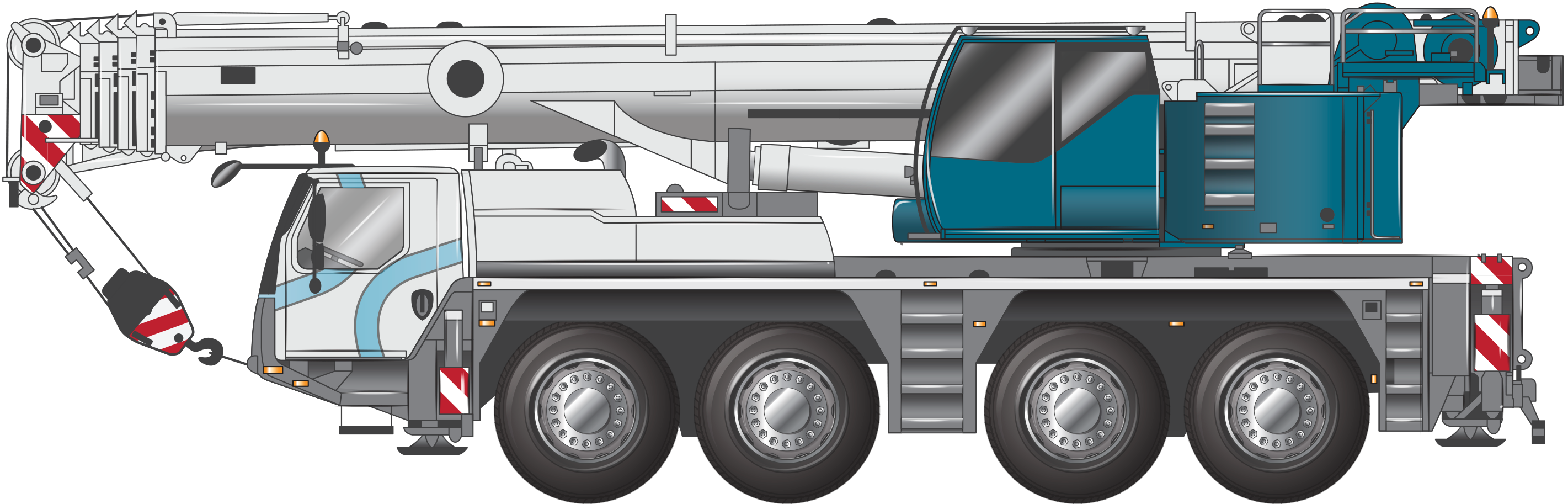 |
| 5-axle all terrain mobile crane | 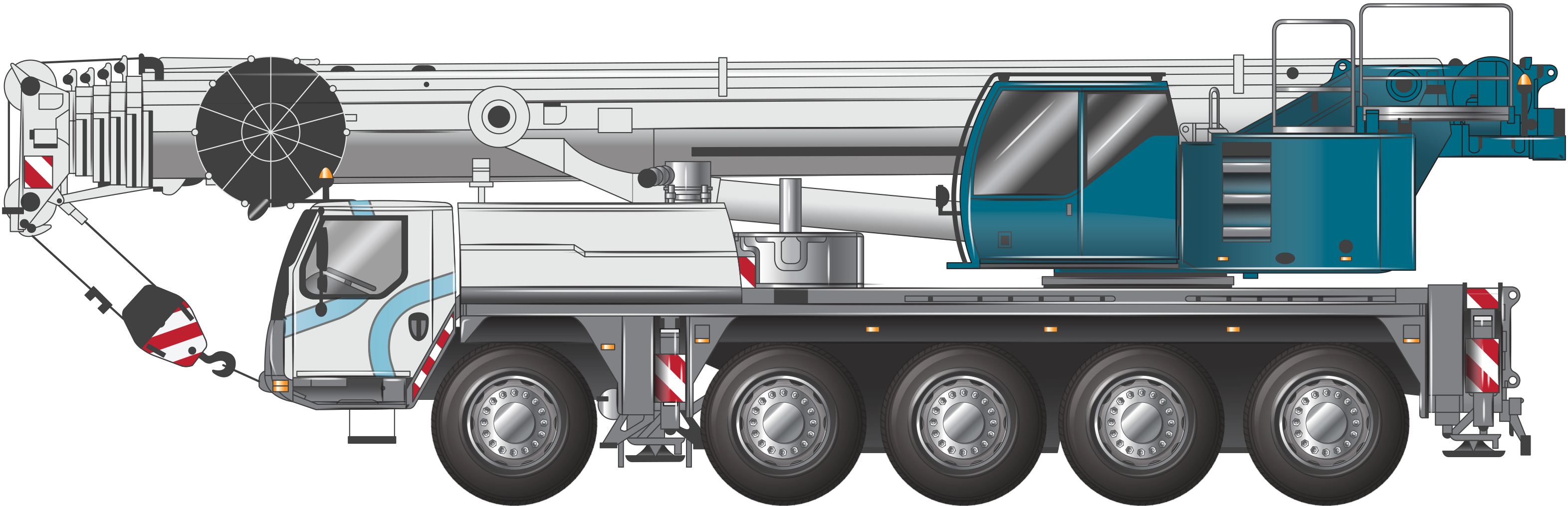 |
| 6-axle all terrain mobile crane | 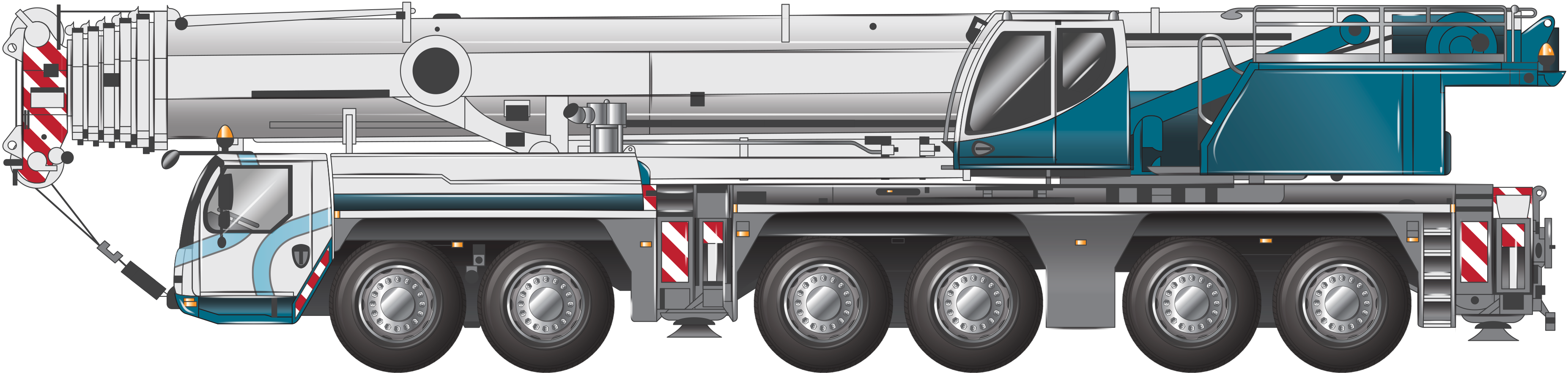 |
Conditions
Notices are subject to various conditions to ensure public safety, protect assets and prevent adverse impacts on the community, such as noise, emissions and traffic congestion. See the sections below for specific conditions related to the Notice.
Dimension conditions - Click to expand
Dimension limits
An eligible vehicle must comply with the dimension limits described in Table 2.
| Eligible vehicle | Maximum length (m) | Maximum width (m) | Maximum height (m) |
|---|---|---|---|
| 4-axle all terrain mobile crane | 14.5 | 3.1 | 4.3 |
| 5-axle all terrain mobile crane | 16.5 | 3.2 | 4.3 |
| 6-axle all terrain mobile crane | 18.0 | 3.2 | 4.3 |
Rear overhang limits
An eligible vehicle must have a rear overhang length not exceeding the lesser of:
- 4.0m; or
- 90% of the distance between the centreline of the front axle and the rear overhang line.
Forward projection
The forward projection of an eligible vehicle must not exceed 3.5m.
Mass conditions - Click to expand
Total mass limits
The total mass of an eligible vehicle must not exceed:
- 48t on a 4-axle all terrain mobile crane.
- 60t on a 5-axle all terrain mobile crane.
- 72t on a 6-axle all terrain mobile crane.
Mass limits for single axle and axle groups
The mass limit on an axle must not exceed 12t.
Pilot and escort conditions - Click to expand
Pilot and escort vehicle conditions
An eligible vehicle exceeding 3.0m wide and operating in the Adelaide Hills area during daylight hours must be accompanied by one pilot vehicle.
For travel at night, the eligible vehicle must be accompanied by pilot vehicles as follows:
- Adelaide Metropolitan Area and South Australia Country Area
- one pilot vehicle if more than 3.1m wide.
- Adelaide Hills area
- one pilot vehicle up to 3.0m wide; or
- two pilot vehicles if more than 3.0m wide.
Where centreline travel is specified on the approved maps, the vehicle must slow to 5km/h and requires a police escort.
Pilot and escort vehicle eligibility
Pilot and escort vehicles must comply with the requirements of Schedule 8 of the MDL to be eligible to escort an oversize vehicle.
Pilot and escort vehicles (Schedule 8, Part 1, Division 5)
- Requirements for a pilot vehicle (including vehicle size and warning sign) – s26
- Requirements for an escort vehicle (including vehicle size and warning sign) – s27
- Headlights on a pilot or escort vehicle (low-beam headlights switched on during the daytime) – s28
- Restriction on what a pilot or escort vehicle may carry – s29
- Where a pilot vehicle must be driven – s30
- Communication between drivers – s31
Warning light (Schedule 8, Part 3, Division 1)
- Characteristics of warning light – s35
- Visibility of warning lights – s36
- Switch for warning lights to be within easy reach – s37
- Warning lights to be on if required, and off if not – s38
Warning sign (Schedule 8, Part 3, Division 2)
- Face of warning sign (outlines surface material requirements) – s41
- Other specifications for warning signs (such as display and maintenance) – s42
- Size and shape of warning sign – s49
- Faces of warning sign – s50
- Fitting warning sign – s51
Exemptions from Road Rules
Rule 311 of the Australian Road Rules exempts the pilot vehicle operator or escort driver from a number of road laws, such as giving way, traffic signs and road markings, keeping left and overtaking, provided that the following requirements are met:
- it is not practicable for the driver to comply with the provision
- the driver is taking reasonable care
- the driver is complying with any other relevant law of this jurisdiction relating to oversize vehicles, including the conditions of any permit or authority issued in relation to the oversize vehicle.
Note: The Rule does not exempt the driver of a vehicle escorting or piloting an oversize vehicle from obeying traffic lights or arrows. Where an oversize load proceeds through a traffic light or traffic arrow, and the pilot is not legally able to follow, the oversize load is required to wait for the pilot to continue, noting that the oversize load can continue to a safe location clear of the intersection. With two pilots, the front pilot may be required to drop behind to cover the load.
Pilot vehicle operating guidelines
Role and responsibilities
The pilot vehicle operator must at all times:
- Provide a visual advance warning, by means of signs and warning lights, to other road users of the approach of an oversize vehicle using the road.
- Maintain the pilot vehicle in an appropriate position in relation to the oversize vehicle to provide adequate warning to other road users of the presence of the oversize vehicle, taking into account traffic speed, weather, visibility and other driving conditions.
- Inform oncoming or overtaking vehicles, by radio where possible, of load dimensions.
- Inform the oversize vehicle driver, by radio, of oncoming traffic, road conditions, bridge and traffic light status, clearance of load from trees and obstacles etc.
- Assess potential hazards and inform the driver of the oversize vehicle accordingly.
- Provide ‘rear vision’ when required due to load width.
Traffic control
Pilot vehicle operators do not have the power or authority to direct traffic. However, they may position their pilot vehicle in such a manner within the appropriate traffic lane to prevent other traffic from conflicting with the turning manoeuvres of the oversize vehicle.
The above duties must be performed in a manner consistent with the requirements of the Road Traffic Act 1961 and Rule 311 of the Australian Road Rules.
Clarification
While pilot(s) and/or escort(s) may be required as part of the exemption, the driver of the oversize vehicle and load remains responsible for the movement of the vehicle on the road and complying with all conditions of the exemption.
Positioning a pilot vehicle(s)
The distance between the pilot vehicle and the oversize vehicle should be adjusted to suit traffic and road conditions to ensure sufficient warning to other road users. Factors that could influence the distance between the pilot and oversize load are:
- traffic volumes
- approaching vehicle speed
- proportion of commercial vehicle traffic
- road alignment and sight distance.
Adelaide metropolitan area
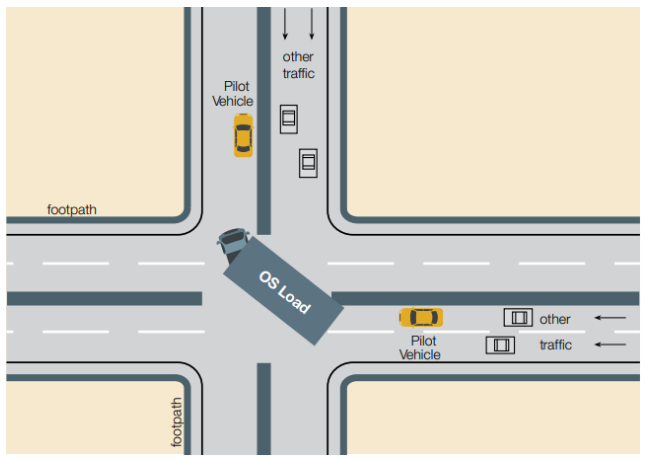
Due to the higher traffic volumes and multi-lane carriageways in the metropolitan area, pilot vehicle operator(s) must remain as close as practical to the oversize vehicle without impeding its passage.
If two pilots are required as a condition of the exemption and the vehicle is operating on a multilane carriageway, the rear pilot should position their vehicle to ‘block’ lanes (within the parameters of Section 2) when the oversize vehicle is turning, to prevent other road users from colliding with the vehicle/load.
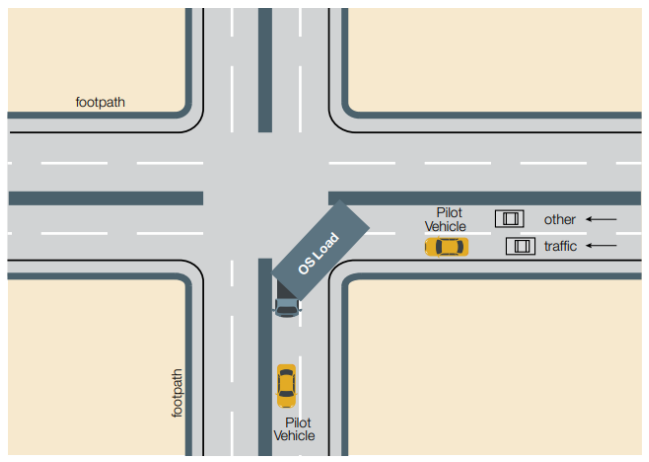
Adelaide Hills
The pilot vehicle operator(s) should generally be positioned well ahead and/or well behind the oversize vehicle in order to provide sufficient advanced warning to approaching traffic of an oversize vehicle.
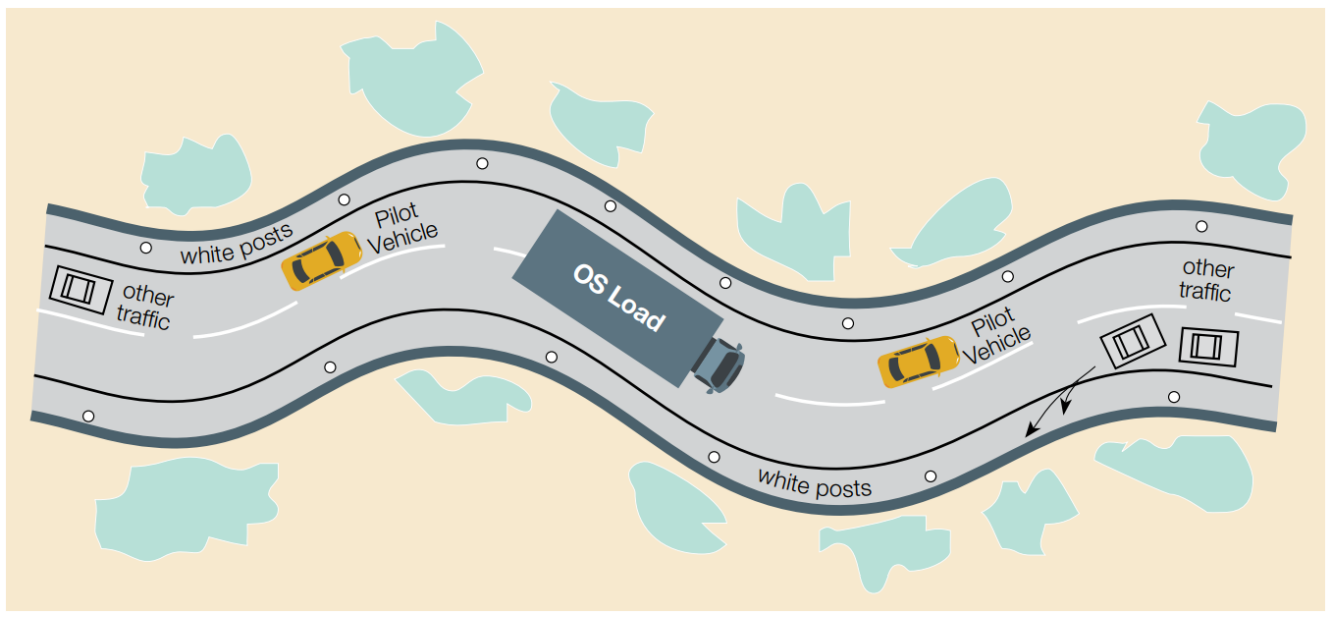
South Australian country areas
The pilot vehicle operator(s) should be positioned well ahead and/or well behind the oversize vehicle depending on the traffic volumes and road conditions in order to provide sufficient advanced warning to approaching traffic of an oversize vehicle.
General conditions - Click to expand
Single tyres and minimum tyre width
An eligible vehicle must have single tyres on each axle. Tyre widths described in Table 3 must not exceed the corresponding mass limit.
| Tyre width of the narrowest tyre on the axle | Mass limit (t) | |
|---|---|---|
| at least (mm) | but less than (mm) | |
| 190 (7.5') | 228 (9.0') | 4.5 |
| 228 (9.0') | 254 (10.0') | 5.0 |
| 254 (10.0') | 279 (11.0") | 6.0 |
| 279 (11.0') | 305 (12.0') | 6.5 |
| 305 (12.0') | 330 (13.0") | 7.0 |
| 330 (13.0") | 356 (14.0") | 7.5 |
| 356 (14.0") | 381 (15.0") | 8.0 |
| 381 (15.0") | 406 (16.0") | 9.0 |
| 406 (16.0") | 458 (15.0') | 10.0 |
| 458 (15.0') | 508 (20.0") | 11.0 |
| 508 (20.0") | - | 12.0 |
| Note: Axle load limits in this table may be reduced by the tyre rating specified either by the Tyre and Rim Association of Australia, or relevant standards, or by the manufacturer of each tyre or rim in relation to inflation pressures, speeds and other relevant requirements. | ||
Carriage of extra equipment
An eligible vehicle may carry up to 1.0t of equipment related to the special purpose of the vehicle. This does not provide extra mass above the conditional mass limits of the Notice.
Night travel
Night travel is permitted within the following areas on the approved networks:
- Adelaide Metropolitan Area
- Adelaide Hills Area
- South Australian Country Area.
An eligible vehicle travelling at night has additional pilot and escort requirements detailed in the 'Pilot and escort conditions' section of the Guide.
Refer to the 'South Australia network conditions' for available networks for night travel.
Hours of operation
Travel within the Adelaide metropolitan area is prohibited between the hours of 7am to 9am and 4pm to 6pm Monday to Friday inclusive.
Speed restrictions
An eligible vehicle must comply with the following conditions:
- The maximum speed must not exceed 80km/h, unless a lower limit applies.
- An 80km/h maximum speed sign must be fitted to the rear of the vehicle.
- A warning decal in the cabin visible from the driver’s position must display a maximum speed limit of 80km/h.
Additional rear marking plates and warning patterns
A rear marking plate must be fitted to the rearmost part of the body of an SPV. The rear marking plate must comply with VSB12 – Rear Marking Plates.
A warning pattern must be displayed on the left and right sides of any rigid projection extending more than 1.2 metres in front of the body of an SPV.
A warning pattern consists of diagonal stripes at least 150mm wide and alternatively coloured either red and white or black and white. The warning pattern must cover an area of at least 0.16m2.


This is in addition to the requirements set out in Schedule 8, section 17(2) of the MDL about rear marking plates and warning patterns.
No travelling if low visibility
An eligible vehicle must not begin to travel if, due to circumstances such as fog, heavy rain, smoke, dust or insect plague:
- visibility is less than 250m in the daytime; or
- the headlights of a vehicle approaching within 250m could not be seen at night.
If an eligible vehicle is already travelling when visibility is reduced to the level mentioned above, the driver must drive the vehicle into the nearest safe parking area and wait until visibility improves beyond that level before continuing to travel.
Minimum following distance
An eligible vehicle exceeding 2.5m in width must be driven at least 200m behind another oversize vehicle travelling in front of it, unless the driver is:
- driving on a multi-lane road or a length of road in a built-up area; or
- overtaking.
Side lights for travel at night with long front projections
When travelling at night, an eligible vehicle with a projection extending more than 1.2m in front of the vehicle must have a yellow light fixed on each side of the projection.
The light must be:
- fixed as far forward as possible, and shielded from the driver’s view; and
- isible to any traffic approaching the vehicle from its front; and
- visible to any traffic approaching the vehicle from the side on which it is fixed.
Other conditions and additional information
Assessing routes before travel
Before an eligible vehicle is driven along any route, its driver and operator must be satisfied that the route has been assessed and that the vehicle can be driven along it without:
- disrupting telecommunication, electricity, rail, gas, water or sewage services; or
- damaging a road (including a bridge), structure, rail crossing or tree.
Prior to commencing a journey, a driver or operator of an eligible vehicle must check for any updates, including relevant road closures and road conditions, restrictions, or limitations affecting the proposed route or that may inhibit the movement of the eligible vehicle.
Third party approvals
Gazette notices, permits and some jurisdictional laws may require third parties and other entities to provide permission for a vehicle to travel if it exceeds certain mass or dimension limits.
Operators must secure all approvals from third parties such as electricity/utility companies, rail authorities and other third parties as part of their heavy vehicle operations.
For more information, visit the Third party approvals page.
Telematics monitoring (TMA)
From 1 January 2027, an eligible vehicle must be enrolled in and monitored by the Telematics Monitoring Application (TMA). Operators are required to install and operate a suitable TMA device in accordance with the details described in in TMA Special Purpose Vehicle Monitoring Schemes (SA) - Transport Certification Australia.
Complying with the HVNL
Unless otherwise exempted by the Notice or this Operator's Guide, operators must ensure their vehicle or combination complies with the:
- Australian Design Rules (ADRs); and,
- Heavy Vehicle National Law (HVNL); and,
- Heavy Vehicle (Mass, Dimension and Loading) National Regulation (MDL); and,
- Heavy Vehicle (Vehicle Standards) National Regulation (VS Regulation).
Failure to comply may result in the driver and/or operator being liable for an offence. Penalties can include infringement notices or prosecution.
Chain of Responsibility (CoR)
Under the HVNL, every party in the Chain of Responsibility (CoR) has a positive duty to ensure the safety of their activities in relation to a heavy vehicle. This duty, known as the “primary duty”, applies to the scheduling, loading and consigning of a vehicle, as well as to its operation on a road.
Safety is broader than the safety of drivers and other road users. It also includes protection of road infrastructure, preventing damage to other vehicles or property, and minimising environmental harm. Substantial penalties may be imposed upon parties who breach this obligation and upon their executives.
For more information on your CoR obligations visit Chain of Responsibility on the NHVR website.
Our Regulatory Advice offers guidance, tips and tools for managing a range of heavy vehicle safety risks.
The requirement to carry the Notice
Drivers do not need to carry a copy of the Notice.
Network and mapping
For the purposes of s121 of the HVNL, an area or route specified in the 'Network & Mapping' section of this Operator's Guide is a stated area or route to which this Notice applies. In addition to complying with the conditions stated in this Operator's Guide, operators must ensure compliance with the specific road manager access requirements set out below or in network maps.
In this tab, you will find the approved routes authorised under the Notice. There may also be network conditions pursuant to the stated areas and routes under the Notice. Network conditions relate to road and travel conditions that are not contained within the Notice.
National Network Map
Certain authorised heavy vehicle road network maps for the Australian Capital Territory, New South Wales, Queensland, South Australia, and Victoria are published by the National Heavy Vehicle Regulator, through the NHVR National Network Map. Additional information and guidance can be found on the National Network Map webpage.
Approved routes covered by the Notice
The following routes are approved for travel for vehicles eligible under this Notice.
Approved routes covered by the Notice - Click to expand
An eligible vehicle complying with the conditions of the Notice may operate on the network specified in Table 4.
| Eligible vehicle | Approved route/network |
|---|---|
| 4-axle all terrain mobile crane | 4-axle All Terrain Crane Network |
| 5-axle all terrain mobile crane | 5-axle All Terrain Crane Network |
| 6-axle all terrain mobile crane | 6-axle All Terrain Crane Network |
Specified road manager network requirements
The following section outlines specific road manager route requirements under the Notice, including route conditions and restrictions.
Road manager route requirements in this section may change from time to time and should be reviewed regularly to ensure compliance.
For further information on how to comply with a requirement, please contact the relevant road manager.
Road managers may publish specific route conditions and restrictions on the approved network map. These must be complied with in addition to any route requirements outlined in this Operator's Guide. If a condition listed in any section of this Operator's Guide conflicts with a route condition or restriction published on an approved network map, the more restrictive requirement applies.
South Australia network conditions - Click to expand
Night travel network restrictions
- 4-axle cranes may operate at night on the '4-axle All Terrain Crane Network'.
- 5-axle cranes up to 3.1m wide may operate at night on the '5-axle All Terrain Crane Network'.
- 5-axle cranes exceeding 3.1m wide may operate at night on the '6-axle All Terrain Crane Network'.
- 6-axle cranes may operate at night on the '6-axle All Terrain Crane Network'.
Heavy Vehicle - Road Operations Access Map (HV-ROAM)
Prior to commencing any journey in South Australia, operators should refer to the Heavy Vehicle – Road Operations Access Map (HV-ROAM) page on the South Australian Government website to assist with journey and route planning.
HV-ROAM should be used alongside the NHVR National Network Map and Traffic SA.
For further information about the map, please visit the Heavy Vehicle – Road Operations Access Map (HV-ROAM) webpage.
Traffic advisory services - Click to expand
Prior to commencing any journey, operators should review traffic alerts, road closures, travel delays, and other traffic advisory information for participating jurisdictions.
Table 5 provides details and links to official traffic advisory services for each participating jurisdiction. For more information about a particular service, contact the relevant jurisdiction or department via the contact details listed on the service webpage.
|
Jurisdiction |
Website |
Purpose |
|---|---|---|
| South Australia | Outback Road Warnings | Access the latest information about temporary closures, restrictions, and warnings for outback roads north and west of Port Augusta. |
| Prescribed burns | Information about upcoming prescribed burns in South Australia that may disrupt travel. | |
| Traffic SA | View live information about incidents and changes in South Australia traffic conditions. Traffic SA is available as a mobile app. See Addinsight download details on the Traffic SA website. |
Applying for a permit - Click to expand
Access permit applications are required for heavy vehicles that don’t comply with the conditions set out in a notice and when accessing routes that aren’t covered on an approved network.
The following pages provide useful information and resources for submitting access permit applications:
- Do I need a permit?: Information and resources for determining whether a road access permit, or a Notice is required to operate on Australian roads.
- Access permit application process: Information, resources, and instructions for submitting a valid access permit application.
Related notices
In this tab you'll find a list of national and state notices related to the South Australia Class 1 4-Axle to 6-Axle All Terrain Mobile Crane Mass and Dimension Exemption Notice 2026 (No.1).
A related notice may coincide with the featured notice or provide alternative solutions for operators to operate under.
Related national notices
| Jurisdiction | Notice |
|---|---|
| National |
Provides mass and dimension access for Special Purpose Vehicles (SPVs) up to a gross mass of 40t. Eligible SPVs include:
|

Related state and territory notices
| Jurisdiction | Notice |
|---|---|
| New South Wales |
Exempts stated Class 1 heavy vehicles from the prescribed mass and dimension requirements specified in the notice, subject to the conditions in the notice and the accompanying Operator’s Guide. Please note the following supporting document for this Notice:
Exempts stated Class 1 heavy vehicles from the prescribed mass and dimension requirements specified in the notice, subject to the conditions in the notice and the accompanying Operator’s Guide. Please note the following supporting document for this Notice:
New South Wales Class 1 Special Purpose Vehicle and Combination Exemption Notice 2024 (No.2) Exempts special purpose vehicles (SPV's) and SPV combinations from specified mass and dimension requirements, subject to certain conditions. Please note the following supporting document for this Notice: |
| Queensland |
Exempt categories of Class 1 special purpose combinations from mass and dimension requirements under the Heavy Vehicle National Law (HVNL). |
|
South Australia |
Grants exemptions from mass and dimension requirements for a Class 1 heavy vehicle that is a 2-axle articulated steering crane. South Australia Class 1 6-Axle to 9-Axle Crane Mass and Dimension Exemption Notice 2026 (No.1) Grants exemptions from mass and dimension requirements for a Class 1 heavy vehicle that is a 6 to 9-axle all-terrain mobile crane or crane combination. |
| Tasmania |
Tasmania Class 1 Special Purpose Vehicle Exemption Notice 2024 (No.1) Exempts eligible Class 1 Special Purpose Vehicles (SPVs) from compliance with certain requirements in Schedule 1 and Schedule 6 of the Heavy Vehicle (Mass Dimension and Loading) National Regulation. |
| Victoria |
Exempts the stated Class 1 heavy vehicles from the prescribed mass and dimension requirements specified in the Notice, subject to conditions. Please note the following supporting document for this Notice: Exempts specified categories of Class 1 Heavy Vehicles from prescribed mass and dimension requirements. This Notice clarifies the need for operators to comply with the Pilots and escort vehicles in mountainous areas requirements. Please note the following supporting information for this Notice: |

Resources
All information about the Notice is contained in this Operator’s Guide. Please refer to the tabs for more information about this Notice, or contact us with your specific questions.
Note: If you have any feedback on the information provided, please contact us at info@nhvr.gov.au
Participating jurisdiction heavy vehicle resources
For more information about operating a heavy vehicle in participating jurisdictions, refer to the following sites:
Changes and updates
| Date | Summary | Links to resources and communications |
|---|---|---|
| 6 February 2026 | South Australia Class 1 4-Axle to 6-Axle All Terrain Mobile Crane Mass and Dimension Exemption Notice 2026 (No.1) commenced. | C2026G00061 |

www.nhvr.gov.au
E info@nhvr.gov.au
P 13 NHVR (136 487)
PO Box 492, Fortitude Valley QLD 4006