
 Road managers
 Accessibility tools


National Class 2 Road Train Authorisation Notice Operator's Guide
National Class 2 Road Train Authorisation Notice Operator's Guide
National
Heavy
Vehicle
Regulator
The National Class 2 Road Train Authorisation Notice 2026 (No.1) authorises the use of class 2 heavy vehicles that are road trains and comply with the conditions of the notice to operate on stated routes and areas in New South Wales, Queensland, South Australia and Victoria.
This instrument does NOT exempt these heavy vehicles from other requirements of the Heavy Vehicle National Law (HVNL), including, but not limited to, other mass and dimension requirements.
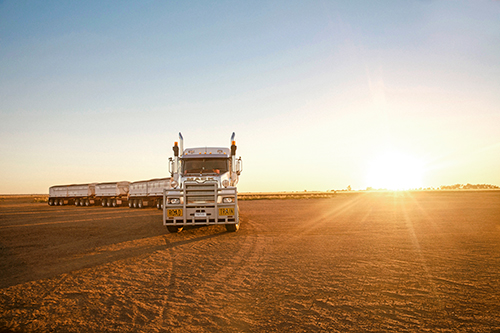
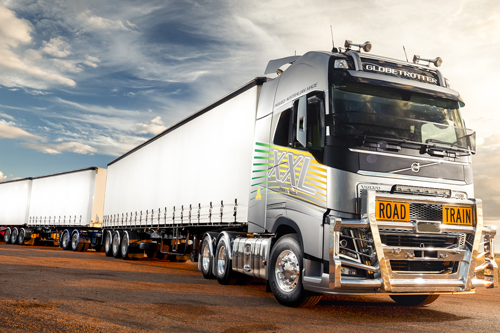
| Specifications | |
|---|---|
|
Gazette Notice: |
C2026G00200 |
| Starts: | 1 April 2026 |
| Expires: | 3 June 2030 |
| Vehicle types: | Class 2, road trains |
| Exemptions: |
Network access |
| Law: | MDL |
| *Coverage: | NSW, QLD, SA, VIC |
| To be carried: | No |
*Specific state conditions are explained below.
- Overview
- Definitions
- Eligible
Vehicles - Conditions
- Network and
Mapping - Related
Notices - Resources
- Changes and
Updates
Overview
The information in this Operator’s Guide is intended to do two things:
- Explain how the National Class 2 Road Train Authorisation Notice 2026 (No.1) (the Notice) operates and to assist in complying with it. This Operator’s Guide is instructional only and it is the Notice that provides the authorisation. If there is a difference or misunderstanding between the Operator’s Guide and the Notice, the Notice has priority and must be followed. The only exceptions are the requirements or conditions set out in the ‘Network and Mapping’ section explained below.
- Provide additional information about mandatory network requirements of the Notice. This includes links to network maps and other information such as vehicle, travel and road conditions. Networks and their conditions published in the ‘Network and Mapping’ section of this Operator’s Guide are not general advice and must be treated as conditions of the Notice.
Please read the Notice and this Operator’s Guide together. To download or print this guide, use the print or PDF buttons on the top right of this page.
About the Notice
This Notice provides access to stated routes and areas (networks) within participating jurisdictions to Class 2 road trains that meet the conditions of the Notice.
Application
The application of the Notice only applies to the extent to which conditions are granted.
The Notice applies to a road train that is a Class 2 road train under s136 of the HVNL that is:
- a combination defined in the Notice; and
- complies with the conditions of the Notice; and
- complies with the conditions of the Schedule of the participating jurisdiction in which it is operating.
The Notice does not apply to:
- a road train that includes a prime mover with a tri-axle drive group; or
- a rigid truck combination that includes a tri-drive group.
A vehicle to which this section applies is an eligible road train.
Authorisation - stated areas or routes
An eligible vehicle accessing a stated map under a Schedule of the Notice must comply with conditions specified for that map in:
- the body of the Notice; and
- the Schedule in which the stated area or route is prescribed; and
- the Network and Mapping section of this Operator's Guide; and
- on the map or stated area or route itself.
Note: Other mass and dimension limits in the MDL apply.
Definitions
Unless otherwise stated, words and expressions used in this Operator’s Guide have the same meanings as those defined in the HVNL and the Notice.
| Term | Definition |
|---|---|
| A-double |
A-double means a heavy combination not longer than 36.5m consisting of a prime mover towing two trailers in which:
|
| A-triple |
A heavy combination consisting of a prime mover towing three trailers in which:
|
| AB-triple |
A heavy combination consisting of a prime mover towing three trailers in which:
|
| ABB-quad |
A heavy combination consisting of a prime mover towing four trailers in which:
|
| B-triple |
A combination consisting of a prime mover towing three semitrailers, with:
|
| B-triple -(modular) |
A heavy combination not longer than 35m consisting of a B-triple in which:
|
| BA-triple |
A heavy vehicle combination consisting of a prime mover towing three trailers in which:
|
| BAB-quad |
A heavy combination consisting of a prime mover towing four trailers in which:
|
| Concessional mass limits (CML) |
Concessional mass limits are mass exceptions that apply as an exception to the general mass limits. CML applies to certain heavy vehicles and the operator of the CML heavy vehicle must hold NHVAS Mass Management Accreditation and the vehicle must be nominated. |
| Converter dolly |
a converter dolly with a roll coupled connection to the vehicle it is towing. |
| Complying steer axle vehicle |
A road train with a single steer axle is a complying steer axle vehicle, if the vehicle has all of the following:
|
| Compliant semitrailer |
A semitrailer or dog trailer that measures not more than:
Note: distances from the coupling are measured from the point of articulation, for semitrailers this is the kingpin, for dog trailers this is the point where the trailer attaches to the dolly. 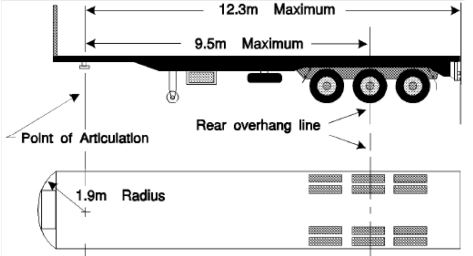 |
| Class 2 |
A heavy vehicle, as it applies to 136(1)(a) of the HVNL, is a class 2 heavy vehicle if it complies with the prescribed mass requirements and prescribed dimension requirements applying to it and is:
|
| D-value |
D-value is a measure of a mechanical coupling’s strength capacity. These values are calculated using methods described in relevant Australasian Standards. The Australasian Standards require a D-value to be permanently marked on a mechanical coupling by its manufacturer. Operators must ensure their road train’s couplings have a sufficient D-value, as required by the Heavy Vehicle (Vehicle Standards) National Regulation. |
| Dog trailer | As defined in the Heavy Vehicle (Vehicle Standards) National Regulation, means a trailer (including a trailer consisting of a semitrailer and converter dolly) that has—
|
| Heavy Vehicle (Vehicle Standards) National Regulation |
This Regulation is made under the HVNL and prescribes the vehicle standards with which a single heavy vehicle or heavy combination must comply for its use on a road. |
| Load-sharing suspension system (of an axle group) |
A suspension system:
|
| Livestock carriers |
A heavy vehicle or combination higher than 4.3m but not higher than 4.6m, built to carry cattle, sheep, pigs, goats or horses. They typically have two, three or four decks. |
| Participating jurisdictions |
Australian Capital Territory, New South Wales, Queensland, South Australia and Victoria. |
| Posted speed limits |
Indicated by sign posts on and varying from road to road. The road rules require that a road train not be operated above a posted speed limit. |
| Prime mover |
A prime mover that:
|
| Rigid truck combination |
A rigid truck towing two dog trailers. |
| Roll coupled connection |
A coupling assembly on a vehicle, including a trailer, designed to connect and provide for articulation between it and another vehicle that:
|
| Specified semitrailers |
A specified semitrailer is eligible that:
|
| Semitrailer |
A semitrailer that:
|
| Type 1 road train |
One of the following combinations as defined under the Heavy Vehicle National Law - National Class 2 Road Train Authorisation Notice
|
| Type 2 road train |
One of the following combinations as defined under the Heavy Vehicle National Law - National Class 2 Road Train Authorisation Notice:
|
| Twinsteer |
A hauling unit that is fitted with a tandem steering axle group. The tandem steer axle group is equipped with single tyres to both axles and connected to the same steering column. The axles are spaced at least 1m apart but no more than 2m apart. The figure below demonstrates the minimum axle spacing requirements of a prime mover fitted with a twinsteer axle group, required to obtain the maximum GML as 11t for load sharing. 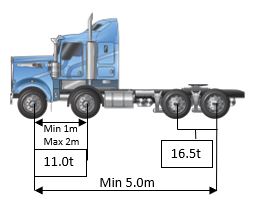 |
| Vehicle Carriers |
A heavy vehicle that is a combination designed and built to carry vehicles on more than one deck that is higher than 4.3m but not higher than 4.6m. |
| Wheelbase | Wheelbase (or inner wheelbase) in relation to a vehicle, means the distance from the centre line of the vehicle’s foremost axle to the rear overhang line. |
Eligible vehicles
To be eligible to operate under the Notice, approved combinations must comply with the conditions of the Notice and all other requirements of the MDL, except where specifically exempted by the Notice.
Combinations eligible to operate under the Notice are Type 1 and Type 2 road train combinations shown in Tables 1 and 2.
The vehicles shown in Table 1 are eligible to operate under the Notice.
A prime mover that has a tri-axle group is permitted to operate as part of an eligible road train in South Australia as Type 1 and Type 2 combinations, as shown in Table 2.
| Road train combination | Road train type | Length limits (m) | State where operation is permitted | |||
|---|---|---|---|---|---|---|
| NSW | QLD | SA | VIC | |||
|
A-double1
|
Type 1 | 36.5 |  |
|
|
|
|
A-double
|
Type 1 | 30.0 |  |
|
|
|
|
B-triple (modular)
|
Type 1 | 35.0 | |
|
|
|
|
B-triple
|
Type 1 | 36.5 | |
|
|
|
|
AB-triple
|
Type 1 | 36.5 | |
|
|
|
|
Rigid truck combination (up to 36.5m)
|
Type 1 | 36.5 | |
|
|
|
|
BA-triple
|
Type 1 | 36.5 | |
|
|
|
|
AB-triple (up to 42m)
|
Type 2 | 42.0 | |
|
|
|
|
BA-triple (up to 42m)
|
Type 2 | 42.0 | |
|
|
|
|
BA-triple (up to 44m)
|
Type 2 | 44.0 | |
|
|
|
|
AB-triple (up to 44m)
|
Type 2 | 44.0 | |
|
|
|
|
Rigid truck combination (up to 47.5m)
|
Type 2 | 47.5 | |
|
|
|
|
A-triple
|
Type 2 | 53.5 | |
|
|
|
|
ABB-quad
|
Type 2 | 53.5 | |
|
|
|
|
BAB-quad
|
Type 2 | 53.5 | |
|
|
|
|
1A-doubles operating in Victoria must not exceed a tandem axle on the converter dolly or operate a twinsteer. Type 2 road train combinations do not have access in Victoria. |
||||||









South Australia eligible road train combinations
| Road train combination | Trailer axle configuration | Length limits (m) |
|---|---|---|
|
A-double (single steer) |
(3-2-3) | 30.0 |
|
A-double (twinsteer) |
(3-2-3) | 30.0 |
|
A-double (single steer) |
(3-3-3) | 30.0 |
|
A-double (twinsteer) |
(3-3-3) | 30.0 |
|
A-double (single steer) |
(3-2-3) | 36.5 |
|
A-double (twinsteer) |
(3-2-3) | 36.5 |
|
A-double (single steer) |
(3-3-3) | 36.5 |
|
A-double (twinsteer) |
(3-3-3) | 36.5 |
AB-triple (single steer) |
(3-2-3-3) | 36.5 |
AB-triple (twinsteer) |
(3-2-3-3) | 36.5 |
AB-triple (single steer) |
(3-3-3-3) | 36.5 |
AB-triple (twinsteer) |
(3-3-3-3) | 36.5 |
| AB-triple (single steer) |
(3-2-3-3) | 42.0 |
| AB-triple (twinsteer) |
(3-2-3-3) | 42.0 |
| AB-triple (single steer) |
(3-3-3-3) | 42.0 |
| AB-triple (twinsteer) |
(3-3-3-3) | 42.0 |
| AB-triple (single steer) |
(3-3-3-3) | 53.5 |
| AB-triple (twinsteer) |
(3-3-3-3) | 53.5 |
A-triple (single steer) |
(3-3-3-3-3) | 53.5 |
A-triple (twinsteer) |
(3-3-3-3-3) | 53.5 |




Conditions
Notices are subject to conditions to ensure public safety, asset protection or to prevent adverse effects to the community such as noise, emission or traffic congestion.
See the sections below for specific conditions related to the Notice.
National dimension requirements - Click to expand
Unless a specific state condition is more restrictive, the following dimension limits apply nationally to an eligible combination.
Dimension requirements
The Notice provides no exemptions to general dimensions applying to road trains. These are the same requirements as those that apply to other Class 2 vehicles and are summarised in Table 3.
| Type of dimension | Maximum dimension limit (metres) |
|---|---|
| Length | See Tables 1 and 2 within the 'Eligible vehicles' tab |
| Width | 2.5m |
| Height | 4.6m for livestock, car carriers and specified semitrailers |
| 4.3m for all other combinations | |
| Rear overhang | 3.7m or 60% of the wheelbase |
Trailer length limits
The Notice does not provide an exemption for trailer length. All trailers must comply with the same prescribed trailer dimension limits that apply to the compliant combinations (e.g. the semitrailer length limits in the MDL Regulation).
National mass limits - Click to expand
Mass requirements
Unless a specific state condition is more restrictive, the following mass limits apply nationally to an eligible combination.
General Mass Limits (GML)
The default mass limit provided by the Notice is GML.
GML applies to all heavy vehicles and is the stated allowable mass for a heavy vehicle axle group, unless the vehicle is operating under an accreditation or an exemption under the HVNL.
General mass requirements apply mass limits for the following:
- those specified by the vehicle manufacturer
- individual axles and axle groups (see Table 4)
- individual components (vehicles and trailers)
- the combination, including as determined by axle spacing requirements
A summary of mass requirements is available on the NHVR website at Mass and dimensions. Mass requirements are prescribed in Schedule 1 of the MDL
Axle groups and mass limits
The maximum mass allowable axle or axle group mass limit under the Notice is summarised in Table 5. To be eligible to operate at Concessional Mass Limits (CML), the axle group must be eligible for the GML shown in Table 4.
| Axle group/tyres | Axle | Axle/vehicle requirements | Tyre section width | Mass limit (t) GML | Mass limit (t) CML |
|---|---|---|---|---|---|
| Steer axle | 
|
Default limit | N/A | 6.0 | |
| Complying steer axle | Suitably rated | 6.5 | |||
| A steer axle forming part of a road train | 295–375 mm | 6.5 | |||
| At least 375 mm | 7.1 | ||||
| Single axle | 
|
Single tyres | Less than 375mm | 6.0 | |
| 375–450mm | 6.7 | ||||
| At least 450mm | 7.0 | ||||

|
Dual tyres | N/A | 9.0 | ||
|
Twinsteer axle group Single tyres |

|
Non-load-sharing suspension system | N/A | 10.0 | |
| Load-sharing suspension system | N/A | 11.0 | |||
| Tandem axle group | 
|
Single tyres on all axles |
Less than 375mm | 11.0 | 11.5 |
| 375–450mm | 13.3 | 13.8 | |||
| at least 450mm | 14.0 | 14.5 | |||

|
Single tyres on one axle and dual tyres on the other axle | N/A | 13.0 | 13.5 | |
 |
Dual tyres on all axles | n/a | 16.5 | 17.0 | |
| Tri-axle group | 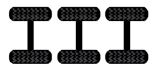
|
Single tyres on all axles | Single tyres less than 375mm | 15.0 | 15.5 |
| At least 375 mm | 20.0 | 21.0 | |||
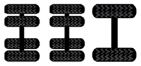
|
Combination of single and dual tyres | Single tyres less than 375mm | 15.0 | 15.5 | |
| Single tyres at least 375 mm | 20.0 | 21.0 | |||
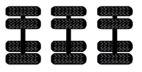
|
Dual tyres on all axles | N/A | 20.0 | 21.0 | |
| Quad-axle group | 
|
Single tyres on all axles | Less than 375mm | 15.0 | |
| At least 375mm | 20.0 | ||||
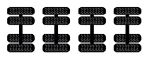
|
Dual tyres on all axles | N/A | 20.0 | ||
Restricted axles
The following axle groups are restricted in the Notice
- A prime mover with a tri-axle group is permitted to operate in South Australia on a specific road train network as listed in Tables 9-11 of this Guide.
- quad-axle groups are prohibited on any road trains operating under the Notice and when on state-controlled roads in Queensland only.
Axle mass spacing limits
In addition to complying with the mass and dimension requirements, road trains must comply with the axle spacing mass limits road train table provided under the MDL Regulation. The distance between axle groups determines the maximum allowable mass over those axle groups.
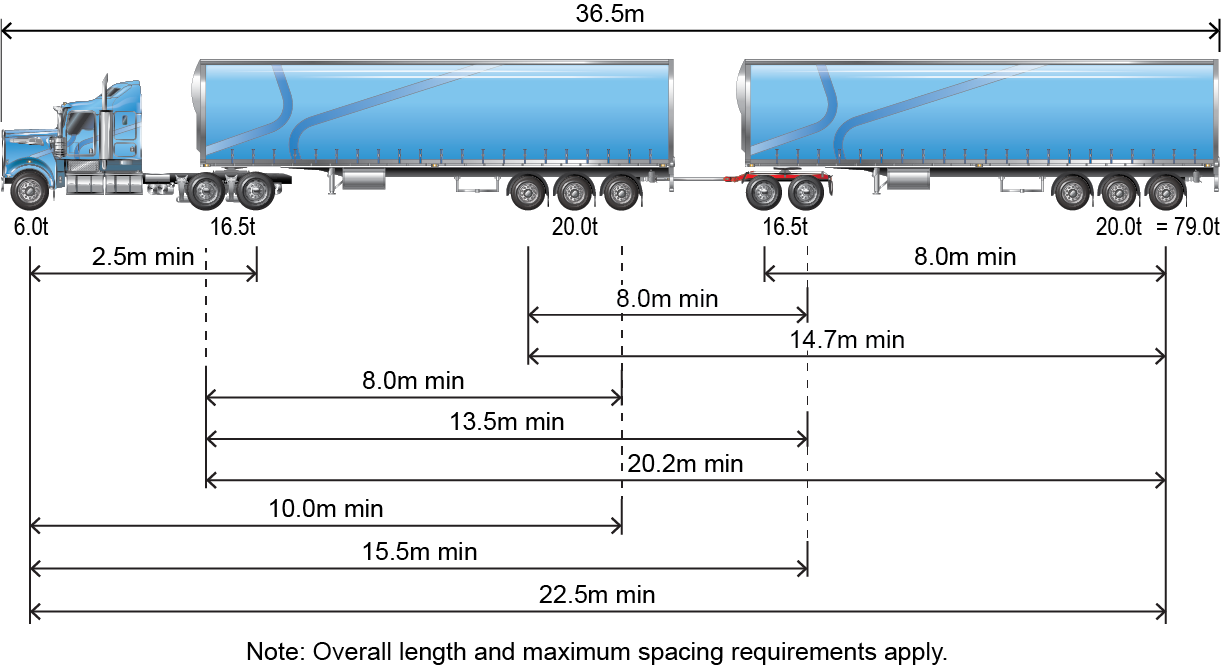
Road train steer mass limits
Road train steer axle mass limits are those at which prime movers can operate when forming part of a road train (see Table 5).
| Steer axle | Mass limit |
|---|---|
| With tyres of section width at less than 295mm, unless a complying steer vehicle | 6.0t |
| With tyres of section width at least 295mm | 6.5t |
| With tyres of section width at least 375mm | 7.1t |
One-tonne mass exception
An eligible combination with a tri-axle group operating under this Notice at GML can apply the one-tonne tri-axle mass exception (1TMTA).
1TMTA allows increased mass on tri-axle groups so they can be loaded up to 1t above the standard tri-axle group 20t GML. Any additional mass loaded onto each tri-axle group is offset onto another non-steer axle or other axle groups.
The 1TMTA does not permit any increase to a vehicle’s maximum (total) mass but gives more flexibility in how mass may be distributed across axle groups.
Vehicles operating under the 1TMTA allowance can access the approved networks in New South Wales, South Australia and Victoria, unless travel is restricted by load limiting signs.
Note: For vehicles operating in Queensland, 1TMTA only applies where the approved routes covered by this Notice are also approved under the 1TMT network. Refer to the 1TMT route (1-Tonne Mass Transfer network) to check approved roads.
For more information, see 1-Tonne Tri-Axle Mass Transfer Allowance information sheet.
Concessional Mass Limits (CML)
Road trains may also load to CML.
Operators wishing to benefit from the productivity gains of CML are required to become an NHVAS member, meet the 8 standards of compliance in the NHVAS Accreditation module - Mass Management and nominate vehicles to participate in the scheme.
CML authorises an increase mass to a nominated heavy vehicle by a maximum of 5% above the GML, subject to:
- a maximum of 1t for a vehicle or combination with an allowable gross mass not exceeding 55t
- a maximum of 2t for vehicle combinations with an allowable gross mass exceeding 55t.
To be eligible to operate at CML, the axle group must be eligible for the GML shown in Table 4.
For more information see Concessional Mass Limits.
Higher Mass Limits (HML)
Road train operators seeking to operate under HML must comply with the conditions of the relevant HML Notice/Declaration.
For more information visit the Higher Mass Limits page or the 'Related Notices’ tab of this Operator’s Guide.
Local mass requirements
Operators must also comply with local mass requirements. These are shown on the maps detailing road train access. These local requirements reflect the limitations of specific road infrastructure. For example, a bridge load limit.
Livestock transportation
This Notice provides GML and CML only. Operators seeking greater mass limits should refer to the respective state livestock notice shown in the 'Related Notices’ tab of this Operator’s Guide.
New South Wales special conditions - Click to expand
Rigid truck and two trailers type 1 road trains
Must not exceed 79t.
Livestock transport
A type 1 A-double transporting livestock must be fitted with a tri-axle converter dolly and the converter dolly must not exceed GML when operating east of the Newell Highway. Details are published on Transport for New South Wales’ road train access maps (see the 'Network and Mapping' section of this Operator's Guide).
Braking requirements
The following additional braking requirements apply in New South Wales:
- The prime mover of a B-triple or AB-triple must be fitted with an anti-lock braking system (ABS) complying with third edition Australian Design Rule (ADR) 64.
- A tank trailer forming part of any heavy vehicle combination and used to transport specified dangerous goods must be fitted with an electronic roll-over control system.
These requirements apply to heavy vehicles, irrespective of when they were built.
South Australia special conditions - Click to expand
Eligible road trains that include a prime mover with a tri-axle group are permitted to operate on state-controlled roads only under this notice.
Eligible road trains that include a prime mover with a tri-axle group are limited to operating on the networks stated in the networks in Tables 9-11 in the 'Network & mapping' tab.
Queensland special conditions - Click to expand
Quad-axle groups
Quad-axle groups must not be fitted on any road trains while operating on state-controlled roads in Queensland.
Victorian special conditions - Click to expand
Eligible road trains
Eligible road trains under this Notice in Victoria are limited to A-doubles with a tandem axle dolly up to 36.5m and have a steer axle mass not exceeding 6.5t. Eligible road trains must not have a twinsteer while operating under this Notice.
All other combinations will need to apply for a permit for access in Victoria.
Additional conditions to those described above apply to road train operation on a road-by-road basis. These are described on the individual roads as displayed on the maps for road train access.
Other conditions and additional information - Click to expand
Assessing routes
Before an eligible vehicle is driven along any route, its driver and operator must be satisfied that the route has been assessed and that the vehicle can be driven along it without:
- disrupting telecommunication, electricity, rail, gas, water or sewage services; or
- damaging a road (including a bridge), structure, rail crossing or tree.
Third party approvals
A third party is an entity with which consultation is required by either State or Commonwealth law, as a condition of operation or access.
Operators must secure all approvals from third parties such as electricity/utility companies, rail authorities and other third parties as part of their heavy vehicle operations.
For more information, visit the Third party approvals page.
Warning signs
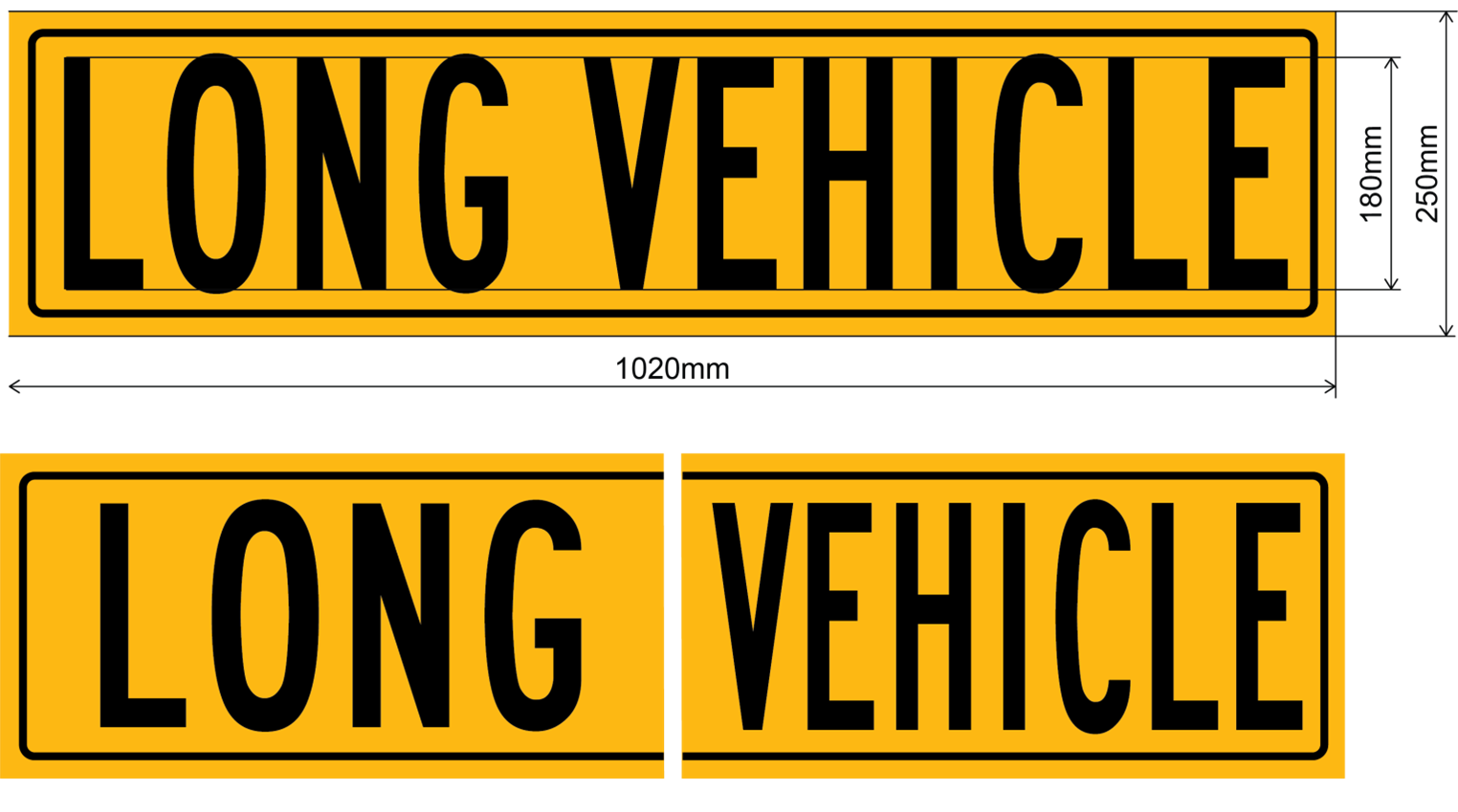
Eligible combinations longer than 22m but not longer than 30m must display a long vehicle warning sign at the vehicle's rear (as shown in Figure 2).
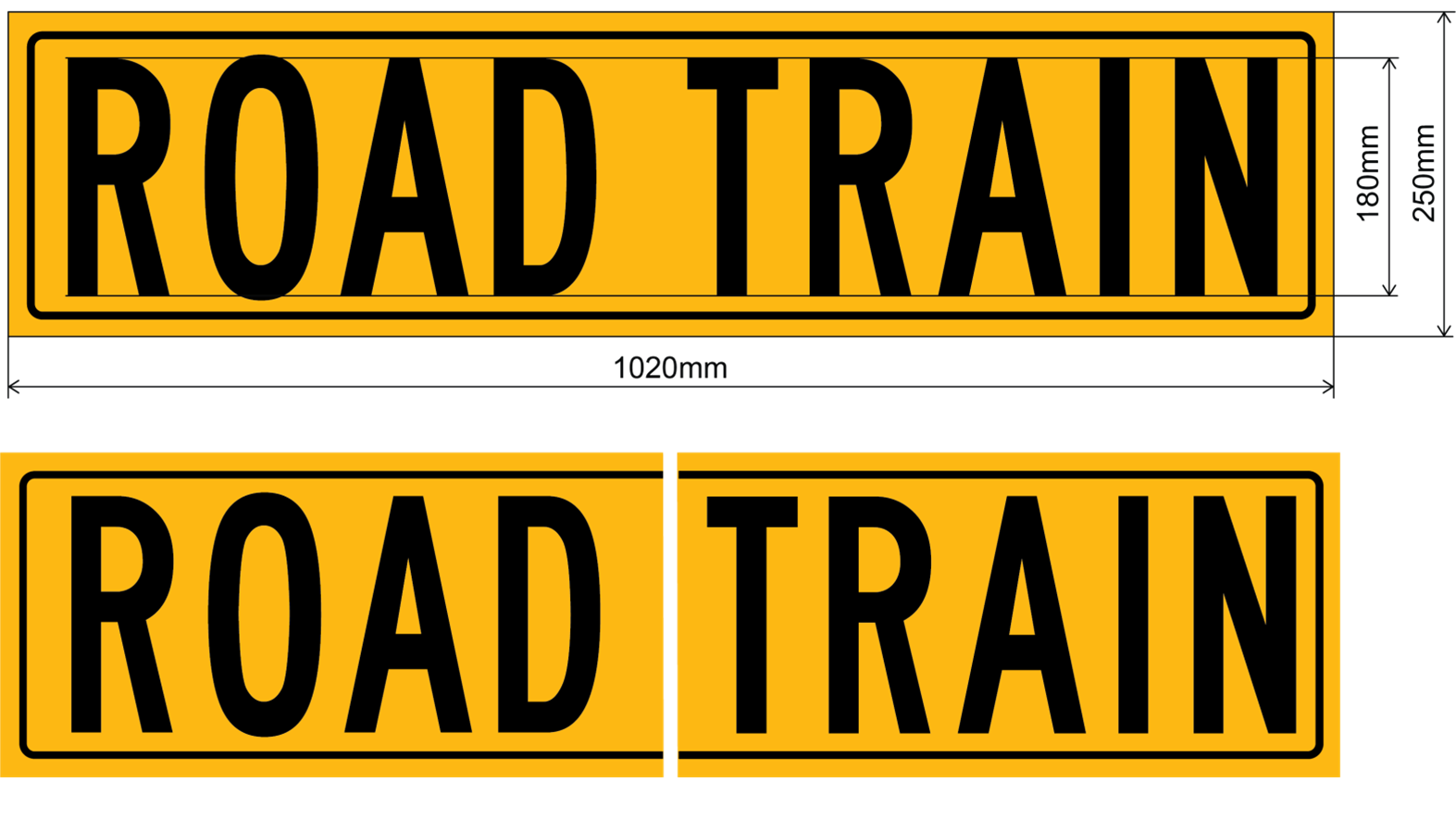
Road trains longer than 30m must display a road train warning sign at the front and rear of the combination (as shown in Figure 3)..
Warning sign requirements are described in the NHVR's VSG19 - Vehicle warning signs (Long vehicle and Road train) (PDF, 547KB).
Complying with the HVNL
Unless otherwise exempted by the Notice or this Operator's Guide, operators must ensure their vehicle or combination complies with the:
- Australian Design Rules (ADRs); and,
- Heavy Vehicle National Law (HVNL); and,
- Heavy Vehicle (Mass, Dimension and Loading) National Regulation (MDL); and,
- Heavy Vehicle (Vehicle Standards) National Regulation (VS Regulation).
Failure to comply may result in the driver and/or operator being liable for an offence. Penalties can include infringement notices or prosecution.
Speed limits
Unless specified in a notice, road train speed limits are determined by the state or territory road authority.
Loading requirements
To meet the loading requirements, the heavy vehicle must be loaded:
- in a way that load placement does not make the heavy vehicle unsafe or unstable
- in a way that the load is not likely to fall or be dislodged from the vehicle
- using an appropriate system to restrain the load.
Visit the NHVR loading page for more information on load requirements.
Chain of Responsibility (CoR)
Under the HVNL, every party in the Chain of Responsibility (CoR) has a positive duty to ensure the safety of their activities in relation to a heavy vehicle. This duty, known as the “primary duty”, applies to the scheduling, loading and consigning of a vehicle, as well as to its operation on a road.
Safety is broader than the safety of drivers and other road users. It also includes protection of road infrastructure, preventing damage to other vehicles or property, and minimising environmental harm. Substantial penalties may be imposed upon parties who breach this obligation and upon their executives.
For more information on your CoR obligations visit Chain of Responsibility on the NHVR website.
Our Regulatory Advice offers guidance, tips and tools for managing a range of heavy vehicle safety risks.
The requirement to carry the Notice
Drivers do not need to carry a copy of the Notice.
Braking requirements
Most braking system requirements are made by the ADR to which the vehicle was constructed. A road train must continue to comply with those requirements.
The VS Regulation makes some additional requirements that apply to road train combinations. These include ensuring there is sufficient air pressure available in the braking system.
The ADRs have also mandated:
- anti-lock braking systems to be fitted on prime movers built from 1 January 2015
- vehicle stability control to be fitted on prime movers built from 1 July 2020
- rollover control systems to be fitted on heavy trailers built from 1 November 2019.
The ADRs' requirements apply to heavy vehicles operating in any state or territory in Australia.
Mechanical couplings and ratings
Mechanical couplings are the devices that connect one component vehicle of a combination to another. They include:
- fifth wheels, king pins and turntables
- pin-type couplings and drawbar eyes on converter dolly couplings.
Eligible road trains are defined in the Notice partly by the types of mechanical couplings with which they are fitted. A key difference between coupling types is their capacity to resist roll between the connected vehicles.
- Fifth-wheel assemblies that utilise two rotating plates are considered to be roll-coupled connections.
- Pin-type couplings and drawbar eyes - a feature of converter dollies - are not considered to be roll-coupled. The pin-type connection to the towing (forward) vehicle offers lesser resistance to roll.
Attachment of couplings and drawbar eyes on road trains
A drawbar-type coupling, or drawbar eye, used in a road train must be built and positioned so that:
- when the road train is moving, the drawbar can move at least 15º upwards or downwards from the position it occupies when the road train is parked on level ground; and
- the pivot point of the coupling is not more than 300mm forward of the rear of the trailer to which it is attached; and
- it is at a height of at least 800mm, but not more than 950mm, when the road train is unloaded and parked on level ground.
- For more information, please refer to VSG31 - Road trains - Trailer coupling requirements (PDF, 475KB).
Key road train trailer couple strength requirements of ADR63/00
All road train trailers built from July 1991 onwards must comply with Australian Design Rule 63/00 - Trailers Designed for Use in Road Trains. ADR 63 requires that they be equipped with mechanical couplings meeting the standards and strength requirements shown in Table 7.
For road train trailers built before July 1991 and not subject to ADR 63/00, requirements made in the VS Regulation apply. Those include complying with the following Australasian Standards and updated/later versions of these:
- AS 2175-1990: Articulated Vehicles – Kingpins
- AS 2213-1984: 50mm Pin-Type Couplings and Drawbar Eyes for Trailers
- AS/NZS 4968.1:2003: Heavy road vehicles –Mechanical coupling between articulated vehicle combinations.
These Australasian Standards describe a method to - and require operators to - calculate coupling strength requirements (minimum D-values). Example calculations are shown in Table 8. Alternatively, values no less than those required by ADR 63/00 and shown in Table 7 are acceptable.
| Coupling type | Relevant Australian Standards | Minimum D-value (kN) |
|---|---|---|
| Fifth wheel assembly |
1773-1990 Articulated Vehicles-Fifth Wheel Assemblies |
162 |
| Fifth wheel kingpins |
2175-1990 Articulated Vehicles - Kingpins |
162 |
| Pin-type couplings and drawbar eyes |
2213-1984 50mm Pin-Type Couplings and Drawbar Eyes for Trailers |
186 |
| Combination type | Dolly converter | Minimum D-value (kN) |
|---|---|---|
| Rigid truck towing two trailers | Tandem axle | 124 |
| A-double | Tandem axle | 128 |
| A-triple | Tandem axle | 161 |
| Tri-axle | 172 |
Network and mapping
For the purposes of s142 of the HVNL, an area or route specified in the 'Network & Mapping' section of this Operator's Guide is a stated area or route to which this Notice applies. In addition to complying with the conditions stated in this Operator's Guide, operators must ensure compliance with the specific road manager access requirements set out below or in network maps.
Road trains may access the routes authorised under the Notice. Approved routes are a combination of areas (all roads within a defined area) and specific roads. These are described on maps published by each state government.
Approved routes covered by the Notice
The following routes are approved for travel for vehicles eligible under the Notice and are available on the NHVR National Network Map.
Approved routes covered by the Notice - Click to expand
| Combination | New South Wales | Queensland | South Australia | Victoria |
|---|---|---|---|---|
|
A-double up to 36.5m
|
GML & CML Type 1 A-double Network |
A-double up to 30m A-double (prime mover with a tri-axle group) up to 30m. (See Table 2)
A-double up to 36.5m A-double (prime mover with a tri-axle group) up to 36.5m. (See Table 2) |
Victoria's Gazetted Road Train Network (northwest of Victoria, with access no further south than Ouyen and Swan Hill). Tandem axle dolly only. | |
|
B-triple (modular) up to 35.0m
|
GML & CML Modular B-triple | Permit required | ||
|
B-triple up to 36.5m
|
GML & CML B-triple | Permit required | ||
|
AB-triple up to 36.5m
|
GML & CML AB-triple |
36.5m Road Train (prime mover with a tri-axle group (See Table 2) |
Permit required | |
|
Rigid truck towing two trailers up to 36.5m
|
GML Type 1 Rigid Truck and 2 Dog Trailers | PBS approval is required for state-controlled roads. | Permit required |





| Combination | New South Wales | Queensland | South Australia |
|---|---|---|---|
|
A-triple up to 53.5m
|
GML & CML Type 2 A-triple |
53.5m Road Train (prime mover with a tri-axle group (See Table 2) |
|
|
AB-triple
|
GML & CML Type 2 A-triple |
Up to 42.0m Up to 44.0m 42.0m Road Train (prime mover with a tri-axle group) (See Table 2)
53.5m Road Train (prime mover with a tri-axle group) (See Table 2) |
|
|
BAB-quad up to 53.5m
|
GML & CML Type 2 A-triple | ||
|
ABB-quad up to 53.5m
|
GML & CML Type 2 A-triple | 53.5m Road Train (GML) | |
|
Rigid truck towing two trailers up to 47.5m
|
GML & CML Type 2 A-triple | 53.5m Road Train (GML) | |
|
*In Queensland, Type 2 road trains are approved for additional access. See 'Queensland Special Network Conditions' for conditions relating to Burke Development Road and Ootann Road. |
|||




| BA-triple length | Network |
|---|---|
|
Up to 36.5m |
PBS Routes Level 3A (state-controlled roads only) |
|
Up to 42.0m long |
PBS Routes Level 3B (state-controlled roads only) |
|
Up to 44.0m long |
53.5m Road Train (GML) (state-controlled roads only) |
Specified road manager network requirements
The following section outlines specific road manager network requirements under the Notice, including route conditions, restrictions, and non-participating road managers.
Road manager network requirements in this section may change from time to time and should be reviewed regularly to ensure compliance.
For further information on how to comply with a requirement, please contact the relevant road manager.
Road managers may publish specific route conditions and restrictions on the approved network map. These must be complied with in addition to any route requirements outlined in this Operator's Guide. If a condition listed in any section of this Operator's Guide conflicts with a route condition or restriction published on an approved network map, the more restrictive requirement applies.
New South Wales special network conditions - Click to expand
The maximum speed limit when operating under this Notice is 90km/h unless a traffic sign indicates a lesser speed limit.
Note: Regulation for road rules (such as speed limits), licensing and registration are a state and territory government responsibility. The HVNL does not provide the NHVR the power to exempt an operator from complying with the road rules.
Queensland special network conditions - Click to expand
Queensland special access for Type 2 Road train travelling on Burke Development Road and Ootann Road
Special access is provided to Type 2 road trains operating in Queensland on the following route:
- Burke Development Road Mungana (From the Type 2 Road train network on Burke Development Road Mungana to the intersection of Ootann road Almaden)
- Ootann Road (Full length of road - From Burke Development Road intersection Almaden to Type 2 Road train network Kennedy Hwy Gunnawarra).
Special conditions for Burke Development Road and Ootann Road
The following conditions apply to Type 2 road trains travelling on Burke Development Road and Ootann Road:
- The following section of Schedule 8 of the MDL Regulation applies to a Type 2 road train travelling on Burke Development Road and Ootann Road under this Notice, as though the eligible vehicle were a Class 1 vehicle:
- Operators must use a 'call point' contact system at signal points along the approved route. Contact should be made on UHF Channel 40.
- The operator must stop and drop dust (dedust) before entering the boundaries of Chillagoe township.
- Note: Dedusting is the process of tapping the wheel rim with a rubber mallet to remove excess dust from the rim. This process assists in reducing dust within the township.
- Type 2 road trains are not to exceed a speed limit of 60km/h on:
- unsealed sections of Burke Development Road between Chillagoe and the Ootann Road intersection; and
- unsealed sections of Ootann Road.
- Vehicles must be separated by a minimum distance of 2km and not operate in convoy.
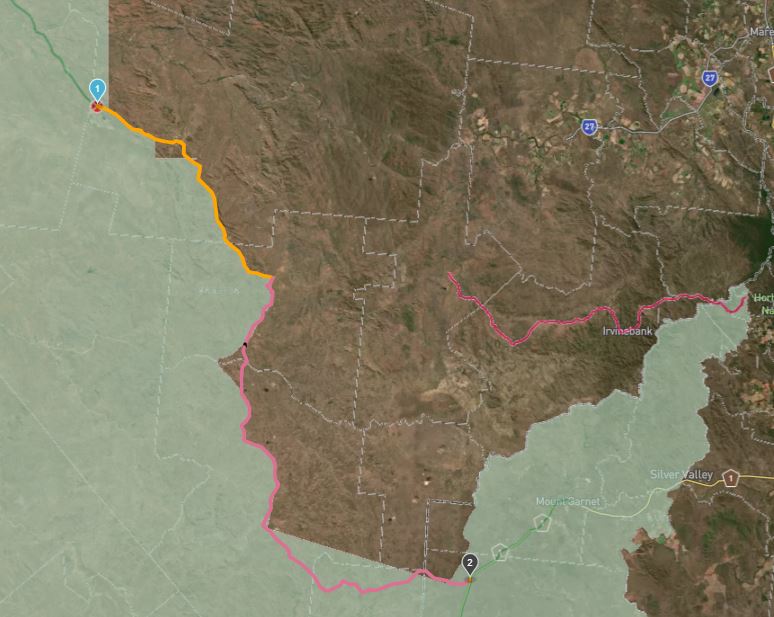
Note: The approved access on Burke Development Road does not extend past the Ootann Road intersection. Access is not provided to Almaden township.
One-tonne mass exception
For vehicles operating in Queensland, 1TMTA only applies where the approved routes covered by this Notice are also approved for 1TMT network. Refer to the Queensland Government Globe to check approved roads.
For more information, see 1-Tonne Tri-Axle Mass Transfer Allowance information sheet.
South Australian special network conditions - Click to expand
South Eastern Freeway Restriction
- Combinations with more than two trailers are strictly prohibited along the South Eastern Freeway.
- Maximum mass limit - 68.5t.
- Maximum length limit - 26m.
Heavy Vehicle - Road Operations Access Map (HV-ROAM)
Prior to commencing any journey in South Australia, operators should refer to the Heavy Vehicle – Road Operations Access Map (HV-ROAM) page on the South Australian Government website to assist with journey and route planning.
HV-ROAM should be used alongside the NHVR National Network Map and Traffic SA.
For further information about the map, please visit the Heavy Vehicle – Road Operations Access Map (HV-ROAM) webpage.
Commodity transport in South Australia
Dedicated road networks for road trains carrying certain commodities are available in South Australia.
These networks provide additional access, beyond that for the same combinations carrying goods other than the specified commodities.
Road trains eligible to operate on the South Australian Commodity networks are:
- A-doubles up to 36.5m long
- B-triples up to 36.5m long (including modular B-triples up to 35.0m long)
- rigid trucks towing two trailers up to 36.5m long.
Detailed information on local conditions for commodity-carrying road trains in South Australia is available in the NHVR National Network Map.
Unconsented level crossings
| Rail manager | ALCAM #* | Road | Suburb | Latitude | Longitude | HV network |
|---|---|---|---|---|---|---|
| Australian Rail Track Corporation (ARTC) |
15 |
Francis Street UP End | Port Adelaide | -34.83903333 | 138.5213056 | 19m HML, PBS 1A, 2A, 2B and 3A |
|
21 |
Heaslip Road | Direk | -34.71077778 | 138.6043611 | ||
|
183 |
Eastern Parade | Ottoway | -34.8435 | 138.5312778 | ||
|
1698 |
Hanson Road North | Wingfield | -34.84001944 | 138.546 | ||
|
1887 |
Eastern Parade - Grand Trunkway | Port Adelaide | -34.83602778 | 138.5148056 | ||
|
2126 |
Francis Street DOWN End | Port Adelaide | -34.83888889 | 138.5209167 | ||
| 658 | Olympic Dam - Pimba | Out of Districts | -31.25155278 | 136.8037889 | 19m HML, PBS 1A, 2A, 2B, 3A, 3B and 4A | |
| * ALCAM # - Australian Level Crossing Assessment Model | ||||||
Ceduna District Council
Road condition
An eligible vehicle must not operate on unsealed roads for routes in an area that has received greater than 15mm of rain in the preceding 24 hours of the rain event.
Speed restrictions
An eligible vehicle whether loaded or unloaded is restricted to the following speeds:
- 80km/h on sealed Council maintained roads with speed limits posted above 80km/h;
- 70km/h on unsealed Council maintained roads with speed limits posted above 60km/h;
- 40km/h on all Council maintained roads with speed limits posted at 60km/h or lower.
Northern Areas Council
The maximum speed limit on sealed local council roads is 80km/h, unless a traffic sign or road rule indicates a lesser speed limit
The maximum speed limit on unsealed local council roads is 60km/h, unless a traffic sign or road rule indicates a lesser speed limit
On unsealed roads, travel is suspended during periods of prolonged rain within the 24 hours period after the rainfall event or when the road's surface is holding pooled water.
Note: When a prolonged rainfall event occurs, the restriction is applied to allow sufficient time for the road and road pavement to dry, preventing damage
Traffic advisory services - Click to expand
Prior to commencing any journey, operators should review traffic alerts, road closures, travel delays, and other traffic advisory information for participating jurisdictions.
Table 13 provides details and links to official traffic advisory services for each participating jurisdiction. For more information about a particular service, contact the relevant jurisdiction or department via the contact details listed on the service webpage.
|
Jurisdiction |
Website |
Purpose |
|---|---|---|
|
New South Wales |
View live information about incidents and changes in New South Wales traffic conditions. |
|
| Queensland | QLD Traffic | View live information about incidents and changes in Queensland traffic conditions, including outback road conditions. |
| South Australia | Outback Road Warnings | Access the latest information about temporary closures, restrictions, and warnings for outback roads north and west of Port Augusta. |
| Prescribed burns | Information about upcoming prescribed burns in South Australia that may disrupt travel. | |
| Traffic SA | View live information about incidents and changes in South Australia traffic conditions. Traffic SA is available as a mobile app. See Addinsight download details on the Traffic SA website. |
|
| Victoria | VicTraffic | View live information about incidents and changes in Victoria traffic conditions. |
Apply for road train permits - Click to expand
A road train permit is required for:
- travel on a road that is not authorised under this Notice; or
- for ineligible combinations including non-compliant road train combinations.
Note: If a road train configuration or axle group type is compliant with the MDL Regulation but is not covered under the Notice, it is still a Class 2 heavy vehicle.
For more information on when you may need a permit refer to the NHVR Road train permit webpage.
BA-triples
BA-triple road train access is limited to South Australia. Access in other jurisdictions is currently under review.
Please refer to the South Australian special requirements when applying for a road train permit (below).
Special jurisdictional requirements when applying for a road train permit
Victoria
For a road train application in Victoria, an operator must supply the vehicle's axle mass and spacing details. These can be provided in two ways:
- completing a custom road train application; or
- attaching a completed additional axle mass and spacing form (PDF, 290KB) to a standard road train application.
If the vehicle's axle mass and spacing details are not supplied with your application, the NHVR or the road manager may request the details through an information request. This would result in delays in processing your application.
South Australia
BA-triples
If access is required on local council roads not included on a network, a permit is required to operate.
You will need to submit an 'Area' application for each local council area, and plot the local roads required for your travel off the approved state network.
How to apply for a BA-triple permit
To begin your permit application, navigate to the NHVR Go. If you are not already registered, follow the prompts to set up an account.
Once registered, from the home screen, click on the ‘Application tracker’ tab and select the ‘NEW APPLICATION’ button and enter a reference for your application.
Note: Where you have an existing permit for an eligible configuration, select the ‘AMEND' application button, which will require the permit number to be entered. Follow the prompts to add the additional routes required.
Step 1 - Click on the green ‘SELECT CONFIGURATION’ button and select the 'Road train' configuration from the list.
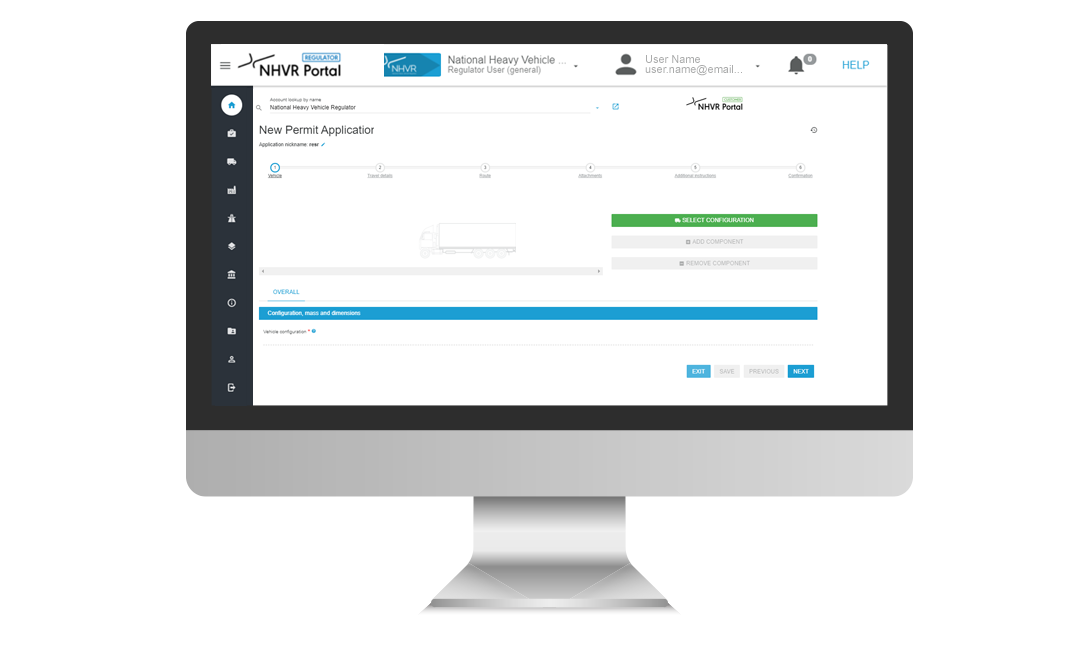
Note: Select the appropriate vehicle being a 'Road Train (incl. HML), Road Train (Livestock), Road Train (Tanker).'
- Once the correct configuration is selected, click on the ‘OVERALL' tab and go to ‘Configuration, mass and dimensions.'
- select the appropriate road train configuration options, this will create an application at General Mass Limits (GML).
- Input the height (4.3m or 4.3m-4.6m).
- Input the length by selecting the appropriate option or adding the vehicle length under the 'Other' button.
- for example, BA-triples in South Australia can select the 'Other' option and input 36.5m, 42m or 44m.
- In both the truck and trailer component images, you must tick the box
☐ " I confirm selection of the correct component" prior to proceeding to the ‘Travel details’ section of the application.
Step 2 - In the ‘Travel details’ section, enter the requested period (the period cannot exceed three years). Input the freight being carried under the 'Description of load', for example, grain, gravel or sand.
Step 3 - Navigate to the ‘Route’ section of the application. Select the ‘Route type' as 'Single Route' or 'Area' – note that the route will need to connect to the approved network specified in the Notice.
- If an ‘Area’ application is selected the ‘Area Road Manager’ must be selected. Refer to Routing - Single route and area difference.
- Plot the route(s) required that link to the approved network.
- Select the ‘CONFIRM’ tab and add any additional information in the ‘Route notes’ section in support of your application. You must tick the box ☐ 'I confirm that the list of roads and associated route notes accurately defines my route requirements for this application' prior to proceeding to the next step of the application.
Step 4 - In the 'Attachments' section of the application, attach any required supporting documents or additional information.
Step 5 - The 'Additional instructions' section allows the nomination of an approved NHVR Go member of your account (if you will not be the relevant contact for the application). Include any additional instructions required for the application.
Step 6 - In the 'Confirmation' stage ensure all details of the application have been reviewed and confirmed. The application can then be submitted with the appropriate payment.
For more information on applying for a permit refer to the NHVR access permit applications webpage, or contact us.
Related notices
In this tab, you will find a list of national, state and territory notices related to the National Class 2 Road Train Authorisation Notice 2026 (No.1).
A related notice may be comparable with this Notice or provide alternatives for operators to find the appropriate notice under which to operate.
Related national notices
| Jurisdiction | Notice |
|---|---|
| National |
National Class 2 4.6m high and/or 25m Long Vehicle Carrier Authorisation Notice 2025 (No.1) Authorises the use of Vehicle Carriers from 4.3 to 4.6 metres in height, or from 19 to 25 metres in length, or both, in stated areas or on stated routes, during stated hours of stated days and states the conditions under which these Vehicle Carriers may be used. National Class 2 4.6m High Livestock Carrier Authorisation Notice 2026 (No.1) Authorises the use of Livestock Carriers from 4.3 to 4.6 metres in height in stated areas or stated routes, during stated hours of stated days and to state the conditions under which these Livestock Carriers may be used. National Class 3 Drought Assistance Dimension Exemption Notice 2025 (No.2) Exempts eligible vehicles from complying with certain dimension requirements when transporting specified commodities for consumption by livestock in drought-affected areas. Exempts a stated category of Class 3 heavy vehicles from the height limit stated in section 8 of Schedule 6 of the Heavy Vehicle (Mass, Dimension and Loading) National Regulation. Please note the following supporting document for this Notice: Exempts a stated category of Class 3 heavy vehicles from the width limit in section 7(1) of Schedule 6 of the Heavy Vehicle (Mass, Dimension and Loading) National Regulation. National Class 3 Road Train Prime Mover Dimension and Mass Exemption Notice 2022 (No.1) Provides length exemption to eligible combinations under the Notice. It also provides flexibility for operators of road train prime movers to continue their travel when decoupling from a road train combination and to access networks when not operating as a road train. National Class 3 Vehicle Carrier Exemption Notice 2025 (No.1) Exempts the stated categories of Class 3 heavy vehicles from the stated dimension requirements of the Heavy Vehicle (Mass, Dimension and Loading) National Regulation specified in the Notice, subject to specified conditions. Exempts a heavy vehicle to which it applies from specified requirements of the Heavy Vehicle (Vehicle Standards) National Regulation. National Heavy Vehicle Work and Rest Hours Exemption (Personal Use) Notice 2025 (No.1) Exempts specified categories of permitted personal activity from the definition of work, with the intention that those activities are not counted as work time for a driver. This Notice combines and replaces the following exemption notices:
Please note the following supporting document for this Notice: |


Related state and territory notices
| Jurisdiction | Notice |
|---|---|
| New South Wales |
New South Wales Class 3 Livestock Transportation Exemption Notice 2024 (No.1) Provides mass exemptions that support the New South Wales Livestock Loading Scheme. This Notice works with the New South Wales Livestock Loading Scheme, and gives effect to the exemptions and conditions of that scheme. Compliance with the scheme is a condition of this Notice. New South Wales Higher Mass Limits Declaration 2025 (No.1) Authorises the use of certain categories of heavy vehicles under higher mass limits on stated areas and routes and states the intelligent access conditions under which these heavy vehicles may be used. Please note the following supporting document for this Notice: New South Wales Class 3 Baled Commodities Dimension Exemption Notice 2022 (No.1) Provides an exemption from height and width dimension requirements for certain configurations of heavy vehicle while they are transporting baled commodities. Please note the following supporting documents for this Notice: New South Wales Class 3 Drought Assistance Dimension Exemption Notice 2023 (No.1) Exempts eligible vehicles from complying with certain dimension requirements when transporting baled or rolled hay to be used as fodder for consumption by livestock in declared drought-affected areas in New South Wales. Please note the following supporting document for this Notice |
| New South Wales and Queensland |
Exempts a stated category of Class 3 heavy vehicles from the height limit stated in section 8 of Schedule 6 of the Heavy Vehicle (Mass, Dimension and Loading) National Regulation. Please note the following supporting document for this Notice: |
|
New South Wales and Victoria |
Exempts semitrailers used to carry livestock from the limit on the deck length available for the carriage of animals stated in section 4(6) of Schedule 6 of the Heavy Vehicle (Mass, Dimension and Loading) National Regulation. |
|
Queensland |
Queensland Higher Mass Limits Declaration 2024 (No.1) Authorises heavy vehicles eligible to use Higher Mass Limits (HML) on stated areas and routes, during stated hours of stated days and to state the conditions under which they may be used. Queensland Class 2 Rockhampton Road Train Authorisation Notice 2025 (No.1) Authorises access for Class 2 heavy vehicles that are Type 1 road trains transporting cattle to Rockhampton abattoirs. Enables eligible B-doubles and road trains to transport large indivisible items in Queensland without the need for a permit, subject to meeting the Notice conditions. Queensland Class 3 Converter Dolly Combination Exemption Notice 2024 (No.1) Exempts Class 3 heavy vehicles towing an unladen converter dolly from the mass limit in Schedule 1, Part 1, Clause2 (1)(a)(iv), and the dimension limit in Schedule 6, Part 2, Clause 3(1)(a) of the Heavy Vehicle (Mass, Dimension and Loading) National Regulation. Queensland Class 3 Heavy Unloaded Trailer and Converter Dolly Dimension Exemption Notice 2024 (No.1) Exempts Class 3 heavy vehicles that are semitrailers towed behind road train rated prime movers from the prescribed height dimension requirement in section 8(d) of Schedule 6 of the Heavy Vehicle (Mass, Dimension and Loading) National Regulation. Queensland Class 3 Heavy Vehicle Additional Concessional Mass Limits Exemption Notice 2024 (No.1) Exempts a stated category of Class 3 heavy vehicles from specified prescribed mass requirements in the Heavy Vehicle (Mass, Dimension and Loading) National Regulation to permit such vehicles additional mass under the concessional mass limits. Queensland Class 3 Livestock Loading Exemption Notice 2024 (No.1) Provides mass dimension exemptions that support the Queensland Livestock Loading Scheme. This Notice is intended to work with the Queensland Livestock Loading Scheme, and compliance with that Scheme is a condition of exemptions contained in this Notice. Queensland Class 3 Rockhampton Road Train Mass Exemption Notice 2024 (No.1) Grants exemptions from mass requirements for Class 3 heavy vehicles that are Type 1 road trains operating under the Queensland Livestock Loading Scheme transporting cattle to abattoirs in Rockhampton. Please note the following supporting document for this Notice: |
|
South Australia |
South Australian Class 3 Road Friendly Suspension Mass Exemption Notice 2026 (No.1) Exempts certain heavy vehicles and combinations fitted with certified Road Friendly Suspension from mass requirements set out in the Heavy Vehicle (Mass Dimension and Loading) National Regulation, allowing operation at masses that are equivalent to Higher Mass Limits under the Heavy Vehicle National Law (HVNL). South Australia Class 3 Baled Commodity Exemption Notice 2024 (No.1) Provides an exemption from height and width dimension requirements for certain configurations of heavy vehicles while they are transporting baled commodities. Vehicles operating under this notice may operate up to the height and width limits specified, provided that they meet the specified conditions. South Australia Class 3 Livestock Transportation Exemption Notice 2026 (No.1) Exempts the use of Class 3 combinations from stated mass limits in Schedule 1 of the Heavy Vehicle (Mass, Dimension and Loading) National Regulation and allows for a specific length exemption for specific 27.5m B-Doubles carrying livestock on a specific route. Please note supporting information for this Notice can be found on the SA Government - Transport of livestock webpage. South Australia Class 3 Specified Routes Dimension Exemption Notice 2025 (No.1) Provides access for road trains that exceed regulation dimensions travelling on limited routes. This Notice has revoked and replaced the South Australia Class 3 Road Train (North of Port Augusta) Dimension Exemption Notice 2024 (No.1). |
Resources
Supporting information
- Classes of heavy vehicles
- Concessional Mass Limits (CML)
- General mass and dimension limits
- Higher Mass Limits (HML)
- Operating a 4.6m high heavy vehicle as a specified semitrailer and under other notices information sheet (PDF, 321KB)
- Road train axle spacing mass limits
- Road train trailer requirements
Vehicle Standards
For a complete list of Vehicle Standards Guide (VSG), please visit the NHVR Vehicle Standards Guide webpage
Key VSG for this Notice are listed below but are not limited to:
- VSG19 - Vehicle Warning Signs
- VSG31 - Road trains - Trailer coupling requirements
Vehicle Standards Bulletin
Key VSB for this Notice are listed below but are not limited to:
- VSB6 - National Code of Practice Heavy Vehicle Modifications
- VSB12 - National Code of Practice Rear Marking Plates for all motor vehicles over 12t GVM and for all trailers over 10t GVM
Third edition Australian Design Rules (ADRs)
The third edition ADRs are located on the Department of Infrastructure, Transport, Regional Development and Communication website. All ADRs' may be reviewed by visiting the website.
Key ADRs for this Notice are listed below but are not limited to:
- ADR 61—Vehicle Marking
- ADR 62—Mechanical Connections between Vehicles
- ADR 63—Trailers Designed for Use in Road Trains
- ADR 64—Heavy Goods Vehicles Designed for Use in Road Trains & B-Doubles
- ADR 65—Maximum Road Speed Limiting for Heavy Goods Vehicles and Heavy Omnibuses
Tools and calculators
Note: This information is intended to provide general guidance only and does not constitute legal advice. We encourage you to obtain independent advice about your legal obligations. If you have any feedback on the information provided please contact us at info@nhvr.gov.au
Road Train MDL Dimension and Axle Spacing Check Sheet
Road Train MDL Dimension and Axle Spacing Check Sheet (XLSX, 60KB)
Considerations
- All of the distances are in metres (m), for example, 1.2m and not 1200mm or 120cm
- All masses are in tonnes (t) and General Mass Limits (GML), even if requesting Higher Mass Limits (HML)
- Steer: 6t
- Tandem: 16.5t
- Tri: 20.0t
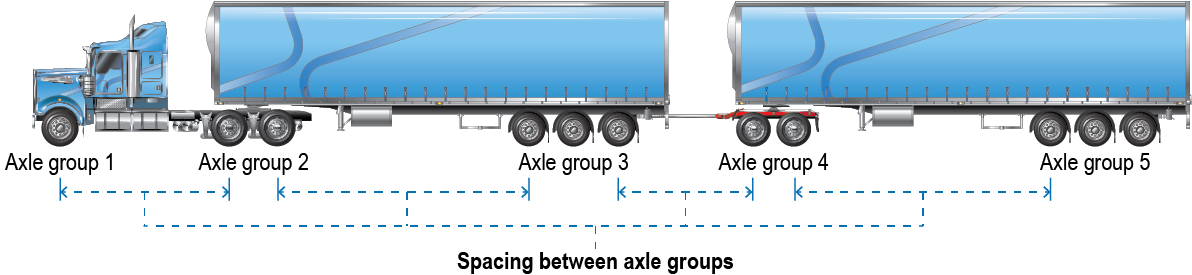
- Distances for axle group length and spacing between axle groups are measured between the axle centres of the extreme axles of each group
Check sheet instructions
- If required, open the 'Vehicle Dimensions' tab and enter vehicle length, height and width; This will show compliance with Heavy Vehicle (Mass, Dimension and Loading) National Regulation (MDL) dimensions.
- Count the number of axle groups (Note: a single axle is one group) and select tab for that number of axle groups
- Enter the number of axles for each axle group in light grey boxes
- Enter MDL GML axle/axle group mass (tonnes) for each axle/axle group in white boxes. (Note: steer axle mass is recorded as 6t)
- In blue boxes, alternately record axle group length (metres) for each axle group (Note: 0 for a single axle) and distance between separate groups
- Scroll across to right and compliance with MDL Schedule 1 tables is indicated as PASS or FAIL
Note: If the result is a FAIL, reducing masses at step 4 or increasing distances in step 5 could provide a PASS result. A PASS result means the given information complies with Road train axle spacing mass limits.
Example: 11 axle A-double (single steer, tandem drive prime mover, triaxle semi, tandem dolly, triaxle trailer) 5 axle groups and 4 spacings between groups. Distances for axle group length and spacing between axle groups are measured between the axle centres of the extreme axles of each group.
Changes and updates
| Date | Summary | Links to resources and communications |
|---|---|---|
| 23 April 2026 |
Removal of restricted level crossings for the following rail managers:
|
|
| 1 April 2026 |
National Class 2 Road Train Authorisation Notice 2026 (No.1) revokes and replaces National Class 2 Road Train Authorisation Notice 2025 (No.2) The South Australia Schedule has been amended to permit a prime mover with a tri-axle group to operate under the notice. |
C2026G00200 |
| 3 October 2025 | Update to Victorian special conditions to include wording "and have a steer axle mass not exceeding 6.5t. Eligible road trains must not have a twinsteer while operating under this Notice." Commencement of National Class 2 Road Train Authorisation Notice 2025 (No.2) | C2025G00540 |
| 26 September 2025 | Update to Table 10: Type 1 road train approved jurisdictional routes, Table 11:Type 2 road train approved jurisdictional routes, to include correct naming and links from the National Network Map. Update to Table 10 also includes B-triple (modular) length to 35.0m. | NHVR National Network Map |
| 4 June 2025 | National Class 2 Road Train Authorisation Notice 2025 (No.1) commenced. | C2025G00269 |
| 9 September 2024 | Update to Table 10: Type 1 Road train approved jurisdictional routes, Table 11:Type 2 Road train approved jurisdictional routes, and Table 12: Networks for BA-triples in South Australia to include correct naming and links from the National Network Map. | NHVR National Network Map |
| 11 October 2023 |
Amendment to Conditions tab. The entire section of National road train speed limits including Table 7: Road train maximum speed limits and Table 8 Summary of speed limit types has been removed. Content has been moved into a separate webpage to help clarify that road train speed limits are determined by the state or territory road authority. |
Road train speed limits |
| 29 August 2023 | Road conditions and speed restrictions added for Ceduna District Council in Network and Mapping under South Australian special network conditions. | |
| 17 January 2022 | How to apply for a permit instructions added to the Network and Mapping tab for South Australian BA-triples. | On The Road Issue 155 - January 17 |
| 16 December 2022 | National Class 2 Road Train Authorisation Notice 2022 (No.3) published. Addition of BA-triples as eligible vehicles in South Australia only. | |
| 14 September 2022 | Amendment to the Queensland Road rule for B-triple speed limits updated. | NHVR Facebook post |
| 1 July 2022 | Amendment to include Type 2 Road train route in Queensland - Special access along Burke Development road and Ootann Road. Update to network and mapping tab. | |
| 4 March 2022 | Amendment to "What is a road train" in the Overview tab. | |
| 4 February 2022 | Publication of the Heavy Vehicle National Law National Class 2 Road Train Authorisation Notice 2022 (No. 1) - Amendment to Table 1 Queensland Networks for Road Trains in Schedule 2 Queensland. Amendment to Application section 7(2)(b). | https://www.legislation.gov.au/Details/C2022G00101 |
| 18 January 2022 | The NHVR added a new tool to the online version of the Road Train Operator’s Guide to help operators check if their axle spacings mass limits comply with the Heavy Vehicle MDL National Regulation | On the Road Issue 132 - 2 February 2022 |
| 13 December 2021 |
The NHVR has released an online operator’s guide for the National Class 2 Road Train Authorisation Notice 2020. The online operator’s guide will replace the PDF guides with one mobile-responsive webpage. Feedback from industry confirmed it’s much easier to find information in these online operator’s guides, which can still be printed as a complete document if operators want to carry a paper copy in their trucks. |
On the Road Issue 130 - 14 December 2021 |
| 1 August 2020 | Removal of maintenance management condition from South Australia | |
| 4 June 2020 | Publication of the Heavy Vehicle National Law National Class 2 Road Train Authorisation Notice 2020 (No. 1) | Expanded national road train network to unlock freight productivity |

www.nhvr.gov.au
E info@nhvr.gov.au
P 13 NHVR (136 487)
PO Box 492, Fortitude Valley QLD 4006